Thinning or Shedding? Telling Temporary Loss From Pattern Loss
Why you can trust this guide: myhair.health earns nothing from anything mentioned on this page. We do earn a commission on some laser devices, which our affiliate disclosure explains.

Shedding and thinning are two different problems that happen to look identical in a shower drain. Shedding is hair letting go early and growing back, usually a few months after a shock to the body. Thinning, in the pattern-loss sense, is hair growing back finer and shorter with each cycle until the scalp shows through at the crown or along the part. The first fixes itself in most people. The second does not, and telling them apart early is the most useful thing you can do before spending a dollar.
What temporary shedding looks like
Temporary shedding, which dermatologists call telogen effluvium, is a sudden rise in the number of hairs falling out across the whole scalp, and it starts months after whatever caused it. The American Academy of Dermatology lists the usual triggers: losing 20 pounds or more, giving birth, a stretch of heavy stress, a high fever, an operation, recovering from an illness, or stopping birth-control pills. A 2015 review in the Journal of Clinical and Diagnostic Research puts the shedding three to four months after the event (Malkud, 2015). That gap is why so many people miss the connection. The surgery was in March. The drain fills up in June.
Two clues point to shedding rather than thinning: volume, meaning handfuls all over the head rather than strands from one zone, and the hairs themselves, which are full length and normal thickness because the follicle was healthy and simply let go early. Starting minoxidil also sets off its own burst of shedding in the first weeks, which our guide to minoxidil side effects walks through.
What pattern thinning looks like
Pattern thinning, androgenetic alopecia, is a slow change in the hair rather than a sudden loss of it: with each growth cycle the follicle produces a finer, shorter hair, until an area looks see-through. The American Academy of Dermatology describes the first sign in men as “a receding hairline or bald spot at the top” and in women as “overall thinning or a widening part”, with hair near the temples sometimes receding too. It is inherited from either parent, and the AAD calls it progressive. There is no event to blame. Nobody finds a clump in the brush. You just notice, in a photo from a wedding, that your part is wider than it was three summers ago.

By the time pattern loss is obvious in the mirror, a fair amount of ground has gone. The back and sides are usually spared, which is why a hand mirror held behind the head is such a useful early-warning tool for men, and why women tend to catch it first at the part line under bright light.
Shedding vs thinning, side by side
Shedding and thinning separate cleanly once you line up six signs instead of staring at the drain.
| Sign | Temporary shedding | Pattern thinning |
|---|---|---|
| How it starts | Suddenly, over a few weeks | Slowly, over years |
| Where | The whole scalp, evenly | Crown, part line, temples; back and sides spared |
| What you find | Handfuls on the brush, pillow and drain | Little extra in the drain, less hair on the head |
| The hairs themselves | Full length, normal thickness | Finer and shorter regrowth |
| A trigger | Usually an event three to four months earlier | Usually none; often runs in the family |
| What happens next | Settles in about six months; fullness back in six to nine | Keeps going without treatment |
Sources: American Academy of Dermatology, “Do you have hair loss or hair shedding?” and “Hair loss: Who gets and causes”; Malkud, Journal of Clinical and Diagnostic Research, 2015.
The two can overlap. A bout of heavy shedding often unmasks thinning that was already quietly under way. If the shedding stops but the crown stays sparse, you are probably looking at both.
The pull test you can do at the sink
The hair pull test is the same quick check a dermatologist does in clinic. Grasp 40 to 60 hairs close to the scalp between thumb and index finger and pull slowly and firmly along their length; normally only two or three come away (Malkud, Journal of Clinical and Diagnostic Research, 2015). Repeat at the crown, both sides and the back. Clearly more than that from several spots points to active shedding. A quiet pull test at a crown that still looks thinner than the sides points toward pattern loss. Treat it as a hint, not a diagnosis.
How to stop hair shedding
You stop telogen effluvium by removing the trigger and then waiting, because the hairs pushed into their resting phase are already on their way out and nothing on a shelf recalls them. The American Academy of Dermatology is plain about the timeline: once the stressor ends, hair tends to regain normal fullness within six to nine months, and shedding that drags on usually means the stressor is still there. So write down what happened three to four months before it began. If nothing stands out, ask your doctor about blood work; the AAD lists thyroid problems and too little iron, protein, zinc or biotin among the causes of noticeable hair loss, and all of those are testable.
What does not work: a shampoo. Anti-dandruff actives reduced shedding modestly in trials and left density unchanged, as our guide to the best shampoo for thinning hair breaks down. Supplements only help if you were short of something. While you wait, handle your hair gently so breakage does not pile on top of the shed; our daily routine for thin hair lists the easy swaps. Six months feels like forever when you are counting hairs on a pillow, but the calendar is the treatment.
When it is time for a dermatologist
See a board-certified dermatologist when shedding lasts past six months, when the loss is patchy, or when the scalp hurts, itches or scales. Six months is where the Journal of Clinical and Diagnostic Research review draws the line between acute and chronic telogen effluvium. Round or oval bald patches are a different condition, alopecia areata, in which the immune system attacks the follicle (AAD), and they need their own workup. If you suspect pattern loss, go sooner: the AAD’s own line is that “the sooner treatment begins, the better the prognosis.”
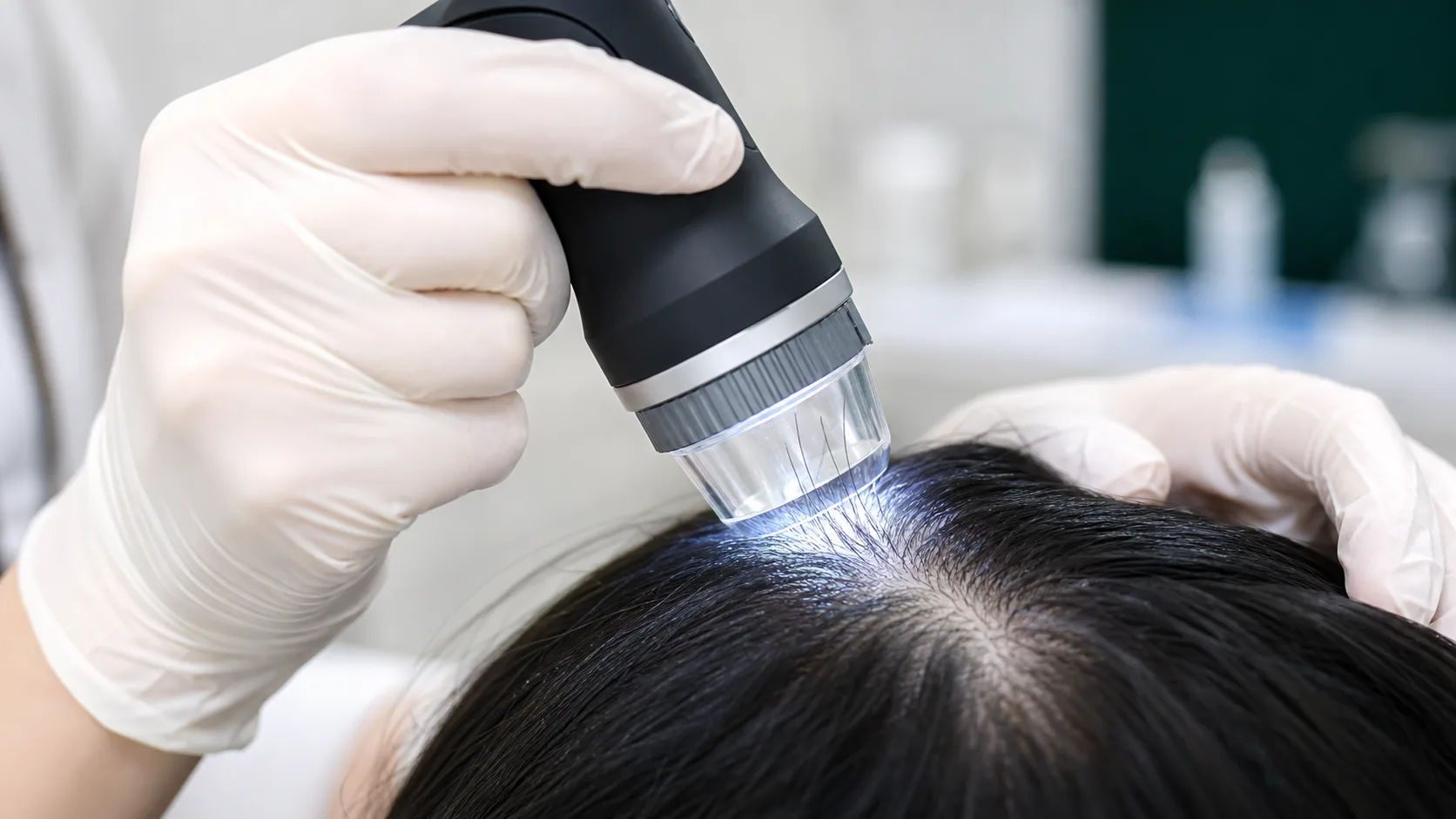
In clinic the guesswork ends fast. A handheld trichoscope lets a dermatologist compare hair shafts at the front of the scalp with those at the back; under the criteria published by Rakowska and colleagues, more than 10 percent thin hairs in the frontal area is a major sign, and two major criteria together diagnose pattern loss with 98 percent specificity (Galliker and Trüeb, International Journal of Trichology, 2012). If the answer is pattern loss, the options with trial data are in our guides to hair loss treatment for men and hair loss treatment for women, and compared side by side on our hair loss treatments page.
Quick answers
How do I know if my hair is shedding or thinning?
Shedding is sudden, all over the head, and leaves full-length hairs on the brush and pillow, usually three to four months after an illness, surgery, childbirth or big weight loss. Thinning is slow, patterned at the part line, temples or crown, and the regrowth is finer. Years of change with no trigger means thinning.
How much hair loss per day is normal?
50 to 100 hairs a day, according to the American Academy of Dermatology. Wash day looks worse because hairs that let go since the last wash come out together, so a hairy drain after one shampoo is not by itself a problem.
How do I stop my hair from shedding?
Find and remove the trigger, then give it six to nine months; the AAD says fullness tends to return in that window once the stressor ends. Blood tests for thyroid and iron are worth asking your doctor about. No shampoo or supplement shortens the wait unless a deficiency was the cause.
Does thinning hair grow back?
Shed hair grows back on its own. Hair thinned by pattern loss can be thickened by treatments such as minoxidil, but only while you keep using them; our guide to whether minoxidil works covers what the trials measured. The AAD notes that in hereditary loss the follicles shrink and eventually stop growing hair, so treatment works best before that point.
Count the months, not the hairs. The calendar usually tells you which problem you have.