Does Minoxidil Actually Work? What the Trials Measured
Why you can trust us: myhair.health earns a commission if you buy through some of our links. Minoxidil is a cheap generic sold everywhere, and we earn nothing for telling you whether it works.

Yes, topical minoxidil works for pattern hair loss, and it has the placebo-controlled trials to prove it, but “works” means more hairs per square centimetre on the top of the scalp, not a restored teenage hairline. That gap between what the trials measured and what the ads imply is where most disappointment comes from. So let’s look at what was actually counted.
What the trials actually measured
Minoxidil trials measured nonvellus hair counts in a small marked patch of scalp, plus how patients and investigators rated coverage. Nonvellus means the thicker, pigmented hairs that actually make a scalp look covered, as opposed to the fine peach fuzz. Researchers tattoo or mark a target area, count the hairs in it at the start, and count again months later.
That method is rigorous. It is also narrow. A hair count in one circle on the crown tells you the drug grows hair; it does not tell you how your part line will look in a bathroom mirror. This is why the better trials add a second layer, asking patients whether they could see the difference, and that second layer is where things get interesting.
The three trials worth knowing
Topical minoxidil has three large, double-blind, placebo-controlled trials behind its over-the-counter formats, all published in the Journal of the American Academy of Dermatology. Here is what each one tested and found.
| Trial (JAAD) | Who | What was compared | Length | Headline result |
|---|---|---|---|---|
| Olsen et al., 2002 | 393 men, 18 to 49 | 5% solution vs 2% solution vs placebo, twice daily | 48 weeks | 5% beat 2% and placebo; authors report 45% more regrowth than 2% at week 48 |
| Lucky et al., 2004 | 381 women, 18 to 49 | 5% solution vs 2% solution vs placebo, twice daily | 48 weeks | 5% beat placebo on all three primary measures |
| Olsen et al., 2007 | 352 men, 18 to 49 | 5% foam vs placebo foam | 16 weeks | Foam beat placebo on hair counts and self-rated improvement |
The 2002 men’s trial is the one to remember. Olsen and colleagues found 5% minoxidil superior to 2% on hair counts and on both patient and investigator ratings, and the 5% group responded earlier. The catch: more itching and local irritation at the higher strength. If that sounds familiar, our guide to minoxidil side effects and shedding covers what is normal.
The 2004 women’s trial by Lucky and colleagues is more nuanced, and I think more honest about the limits. The 5% solution beat placebo on every primary measure. The 2% solution beat placebo on hair counts and investigator ratings, yet the women using it could not tell a significant difference from placebo themselves. Hairs were counted. Women did not always see them. The 5% group also saw more unwanted facial hair (hypertrichosis). For the full picture on formats and dosing for women, read what the minoxidil label allows for women.
The 2007 foam trial settled a practical question: a propylene glycol-free foam still works. The authors themselves flag its main weakness, though. Efficacy data stopped at 16 weeks.
Where minoxidil falls short
Minoxidil falls short in three predictable places: the front of the head, people who stop using it, and people whose hair loss is not the pattern kind. None of this is hidden. It is printed on the box.
The men’s 5% foam label directs use on the top of the scalp only and says the product “will not work for all men.” It also states that “continued use is necessary to increase and keep your hair regrowth or hair loss will begin again.” Read that twice. You are signing up for maintenance, not a one-off fix. If that, or the scalp irritation, pushes you toward a cosmetic serum instead, read which serum ingredients have trial data before you switch, because only caffeine and rosemary oil have a trial that held up against minoxidil.
The same label tells you not to use it if your hair loss is sudden or patchy, if you have no family history of hair loss, or if you do not know the reason for it. Those are the cases where something else, a thyroid problem, iron deficiency or an autoimmune condition, may be going on, and a doctor should look before you spend a year on foam. The label also says to ask a doctor first if you have heart disease.
How to give minoxidil a fair test
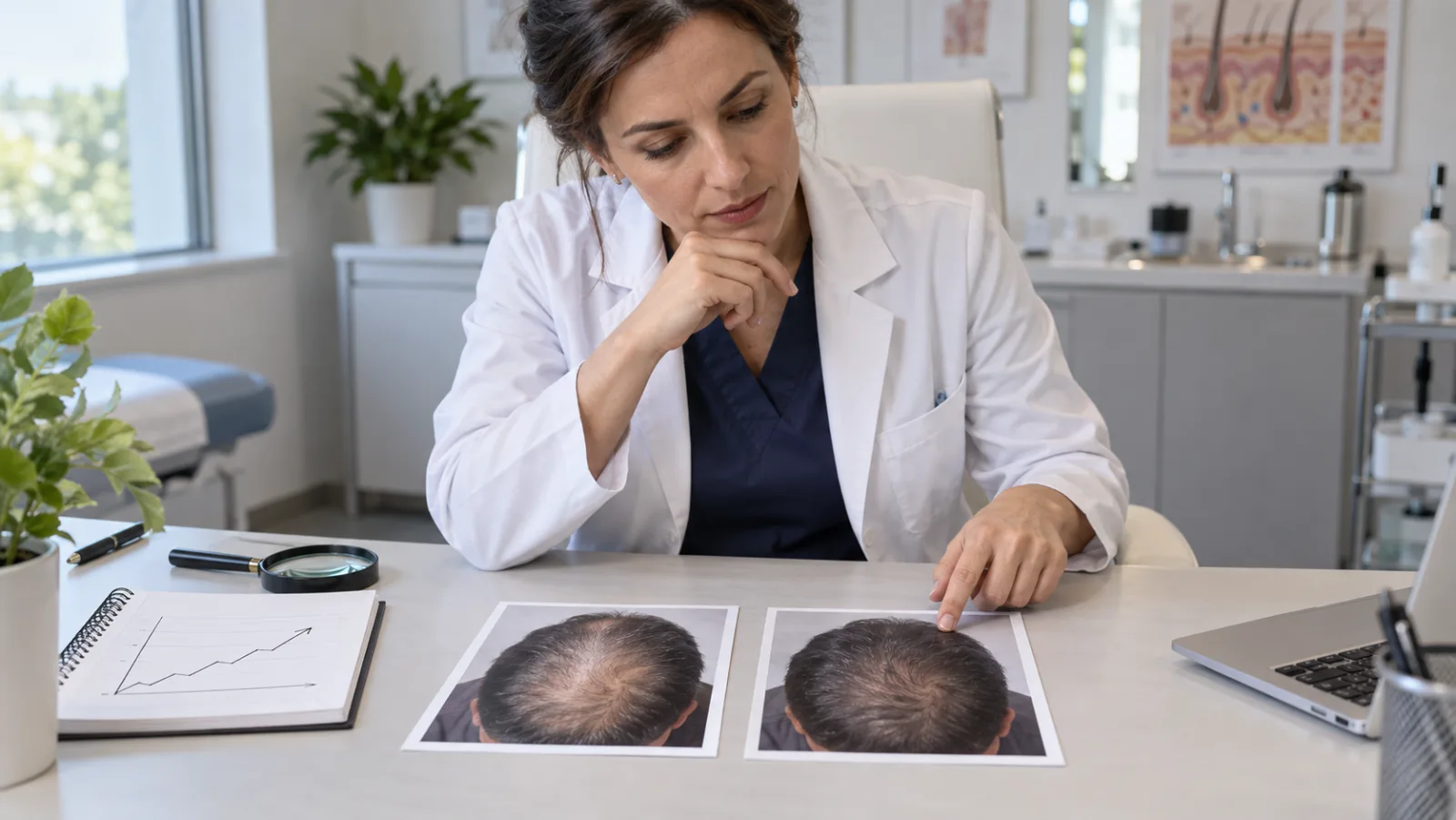
A fair minoxidil test takes at least four months of twice-daily use with photos, because the men’s foam label says to stop and ask a doctor only if you see no regrowth after 4 months. Most people quit earlier, often during the early shedding phase, and then decide it “didn’t work.”
- Photograph before you start. Same room, same light, same angle, hair dry. Repeat monthly. Your memory is a bad instrument.
- Apply the labelled dose, not more. The label says using more or more often will not improve results.
- Judge at month four, not week three. Earlier verdicts are noise.
- Stop and call a doctor if you get chest pain, a rapid heartbeat, dizziness, swollen hands or feet, or sudden weight gain, as the label directs.
- Plan for the long haul. If it works, you keep using it.
If the ritual is the problem rather than the results, oral minoxidil versus topical is a conversation worth having with a dermatologist. And if you want to see how minoxidil stacks up against devices, finasteride and the rest, start with our overview of hair loss treatments. If you want more out of the same bottle, derma roller and scalp massage explains which of the two actually adds to minoxidil, and the rules for doing it without wrecking your scalp. If the choice is minoxidil or the pill, finasteride vs minoxidil explains why many men end up on both. For where minoxidil fits next to finasteride at each Norwood stage, see hair loss treatment for men. And if the yearly cost is what holds you back, Kirkland minoxidil versus Rogaine shows you are paying brand prices for an identical ingredient list.
Questions people actually ask
Is 5% minoxidil better than 2%?
In men, yes on the evidence. The 2002 JAAD trial by Olsen and colleagues found 5% topical minoxidil clearly superior to 2% at 48 weeks, with an earlier response, though it caused more itching and irritation.
Will my hair fall out if I stop minoxidil?
The men’s 5% foam label says continued use is needed to keep regrowth, “or hair loss will begin again.” Minoxidil does not change the underlying pattern hair loss; it only works while you use it.
Does minoxidil work better than rosemary oil?
Minoxidil has far more placebo-controlled evidence behind it. Rosemary oil’s case rests on much thinner data, which we break down in rosemary oil versus minoxidil.
Can I combine minoxidil with a laser cap?
Plenty of people do, but none of the minoxidil trials above tested that pairing. Two 2025 meta-analyses of the combination reached opposite conclusions, and we lay both out in red light therapy vs minoxidil. See what the laser cap trials show and ask your dermatologist before stacking treatments.
Minoxidil is not magic, and it is not a scam either. It is a modest, proven, boring drug that rewards patience on the crown and disappoints anyone expecting a new hairline. Go in with the right expectations and a camera, and see a doctor if your hair loss does not fit the pattern.