iRestore Review: What the Clinical Evidence Actually Shows
iRestore is FDA-cleared and backed by real laser-therapy trials, but it costs $799 to $2,699 and only works on early-stage hair loss. Here is who should skip it.
Why you can trust us: myhair.health earns a commission if you buy through our links. That commission never changes our testing results or which device we recommend.
iRestore is a legitimate, FDA-cleared laser hair-growth device whose underlying therapy has real clinical evidence behind it, and it is also expensive, slow, and useless for the people who most want it to work. Both halves of that sentence matter. The iRestore Elite costs $2,699. The published trials that support this category show meaningful regrowth only in people who still have living follicles to stimulate, and only after months of consistent use. This page separates what the evidence supports from what the marketing implies.
How iRestore actually works
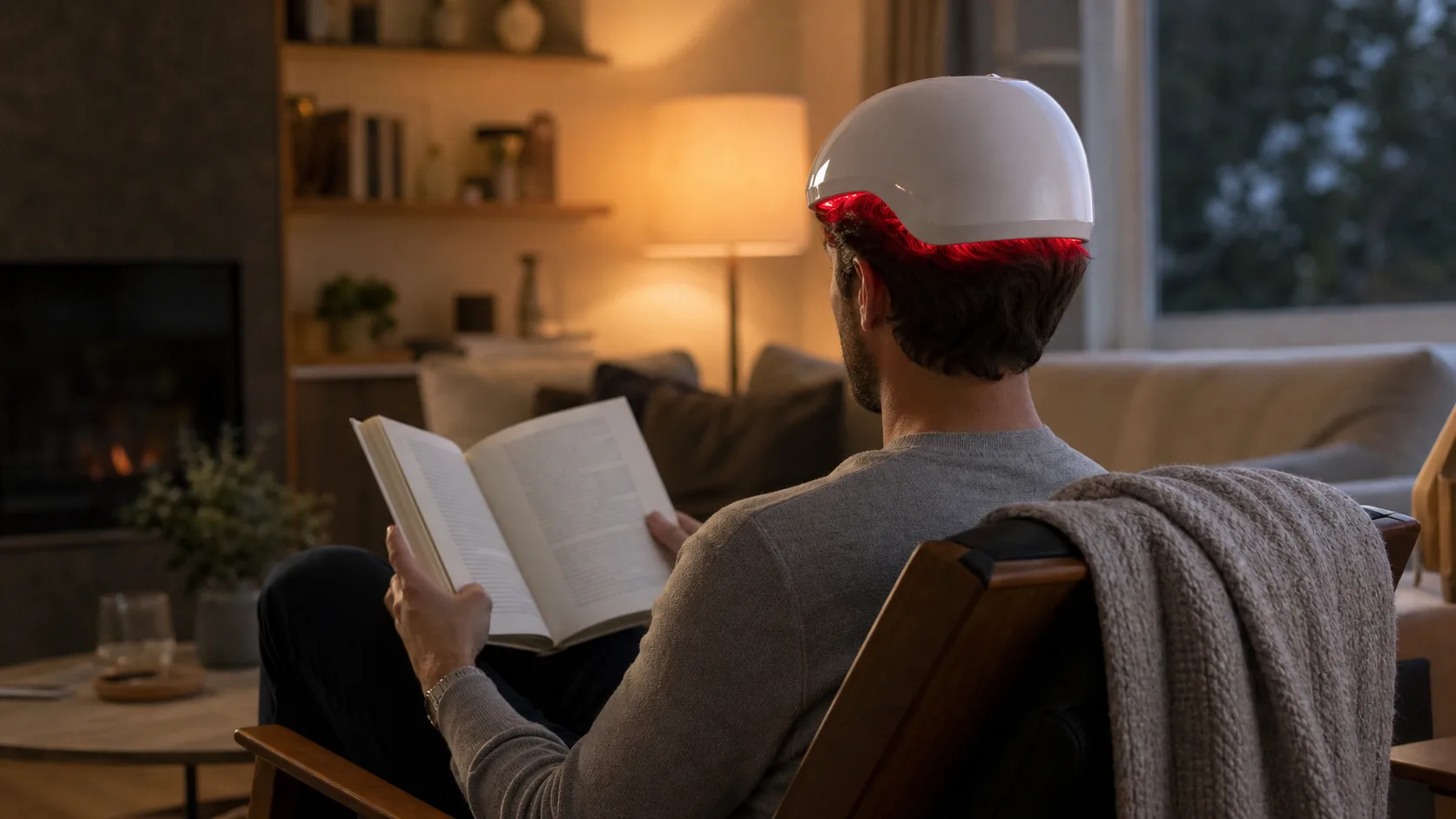
iRestore is a low-level laser therapy (LLLT) helmet that shines red light at roughly 650 nanometres onto the scalp to stimulate follicles that are still alive but miniaturising. The mechanism, called photobiomodulation, is thought to increase cellular energy production in the follicle and push hairs from the resting (telogen) phase back into the active growing (anagen) phase. iRestore does not add hair; it attempts to wake up hair you still have.
This distinction decides whether iRestore will work for you. A follicle that has been dormant for years and scarred over is not going to respond to red light. iRestore is a treatment for thinning, not for baldness, which is precisely why the trials below recruit people with pattern hair loss rather than people who are already bald.
What the clinical evidence shows
The evidence for helmet-style low-level laser therapy is genuinely positive, and it is stronger than most supplement-tier hair products can claim. Below are the findings that matter, with the numbers rather than the adjectives.
In a 12-month prospective trial published in Dermatologic Therapy, participants using a helmet-type red-light device (646-675 nm, three times a week for 20 minutes) went from a mean hair density of 99.2 hairs/cm² at baseline to 124.2 hairs/cm² at 48 weeks, a mean gain of about 25 hairs per square centimetre, alongside a roughly 15% increase in hair shaft thickness. That is the single most useful number on this page, because it is measured over a realistic timeframe with the same device format iRestore sells.
A 16-week multicentre, randomised, double-blind, sham-device-controlled trial of a helmet-type LLLT device found the treated group gained 41.9 hairs/cm² while the sham group gained 0.72 hairs/cm². The sham arm is what makes this finding credible: the people wearing a fake helmet, with all the same expectations and routine, saw essentially no change. The light is doing the work, not the ritual.
A separate randomised, double-blind study using 650 nm light three times weekly over 24 weeks reported greater hair coverage in the treated scalp (14.2%) than under sham treatment (11.8%). The effect is real but modest, and that modesty is the honest headline for this entire device category.
Low-level laser therapy has been FDA-cleared for androgenetic alopecia since 2007, and iRestore’s devices carry that clearance. Clearance is a regulatory statement about equivalence and safety, not a government endorsement that the device will work for you.
Sham device identical, inert
+2 to +9 hairs/cm²
Real laser device 26 weeks
+18 to +26 hairs/cm²
The real device grew roughly four times the terminal hair count of the sham over 26 weeks.
These are matched arms of a single double-blind, sham-controlled trial (Jimenez et al., 2014), not two studies spliced together. Every real-device model beat its matched sham, and every difference was statistically significant.
We do not publish before-and-after photographs. A photo taken under different lighting six months apart proves nothing, and every brand in this category knows it. These are measured terminal-hair counts from one published trial, not our customers and not our claims.
How we evaluate these devices
myhair.health does not run before-and-after photo galleries, because a photo taken under different lighting six months apart proves nothing. Instead we score laser devices on the four variables that published trials and FDA filings actually track: the wavelength and whether it falls in the evidence-backed 650 nm window; the number and type of light-emitting diodes and how they are distributed across the scalp; the required treatment schedule and session length; and the return policy, which is the only thing standing between you and a $2,699 mistake.
Where we cite a result, we cite the trial. Where a manufacturer claim has no trial behind it, we say so.
What an independent reviewer actually found
We quote only real, published reviews, linked so you can read them in full and in context. We do not write testimonials, we do not pay for them, and we do not quote anything we cannot link you to.
After just two months, my husband saw enough hair regrowth that his college friends commented on it.
iRestore Elite vs Professional vs Essential
iRestore sells three hair-growth helmets, and the only meaningful difference between them is coverage, how many diodes are firing at your scalp and therefore how much of your head is being treated per session.
| Model | Diodes | Price | Best for |
|---|---|---|---|
| iRestore Elite | 500 | $2,699 | Diffuse thinning across the whole scalp; the most complete coverage iRestore sells |
| iRestore Professional | 282 | $1,499 | The reasonable middle: real coverage without the Elite’s price |
| iRestore Essential | 120 | $799 | Entry point; noticeably fewer diodes, so coverage is the trade-off |
The value question is coverage per dollar. The iRestore Elite delivers 500 diodes for $2,699, about $5.40 per diode. The iRestore Professional delivers 282 diodes for $1,499, about $5.32 per diode. The two are nearly identical on that measure, which means the Elite is not a rip-off relative to the Professional; you are simply buying more scalp coverage. The iRestore Essential, at $799 for 120 diodes, works out to $6.66 per diode, the cheapest device is the worst value per unit of light.
iRestore Elite · $2,699
Affiliate link. We may earn a commission at no extra cost to you.
What iRestore really costs
iRestore’s entry price is $799 and its ceiling is $2,699, which makes it one of the most expensive at-home hair devices you can buy. Before you reach for a bundle, understand what iRestore’s bundles actually are.
iRestore’s device-plus-mask bundles are not discounts. The Elite + Illumina Face Mask bundle sells for $3,498, which is exactly $2,699 for the Elite plus $799 for the face mask. The Illumina LED Trio sells for $1,947, which is exactly the sum of its three masks ($799 + $649 + $499). You save nothing by bundling those items; you are just buying two things in one transaction. Real savings on iRestore come from seasonal sales and from the larger multi-device bundles, not from clicking “bundle” on a device and a mask.
The one genuinely reassuring number: iRestore offers a 12-month money-back guarantee. A full year is longer than any of the trials above needed to show measurable change, so the return window genuinely covers the period in which you would find out whether the device works on your head.
For the full pricing breakdown and the cost of laser therapy against minoxidil and transplants, see our iRestore cost analysis. If you are ready to buy, check current iRestore discounts first.
If the balding area of your scalp is already smooth, the follicles are gone. No laser helmet on earth brings them back, and iRestore will not either.
Who should skip iRestore
iRestore is the wrong purchase for more people than iRestore’s marketing admits. Skip it if your scalp is already smooth and shiny in the balding areas, the follicles are gone, and no amount of red light resurrects them. Skip it if you will not commit to three sessions a week, every week, for at least six months; the trials that produced those hair-count gains were built on relentless consistency, and the benefits fade if you stop. And skip it if $1,499 to $2,699 is money you need, topical minoxidil costs a fraction of that and has its own solid evidence base.
What holds up
- FDA-cleared, with real randomised sham-controlled evidence behind the therapy
- Hands-free helmet design, no daily topical mess, no drug side effects
- 12-month money-back guarantee, long enough to actually judge results
- Elite's 500 diodes give genuinely broad scalp coverage
What does not
- Very expensive: $799 to $2,699, the top of the market
- Slow: expect nothing visible for 4-6 months
- Only works on living follicles, useless on an already-bald scalp
- Requires permanent 3x-weekly use; gains reverse if you quit
- The device-plus-mask bundles offer literally zero savings
Questions people actually ask
Is iRestore legit?
Yes. iRestore is a real FDA-cleared medical device from an established company, not a supplement scam, and the low-level laser therapy it uses is supported by randomised sham-controlled trials. Legitimate does not mean it will work for everyone.
Does iRestore work on a receding hairline?
Poorly. A receding hairline usually means the follicles at the temples have already miniaturised past the point where light therapy helps. iRestore performs best on diffuse thinning at the crown and mid-scalp, where follicles are weakened but alive.
How often do you use the iRestore helmet?
Three times a week, about 25 minutes per session, indefinitely. The published trials that showed hair-count gains used exactly this cadence for 16 to 48 weeks, and the gains diminish once treatment stops.
Is iRestore FSA eligible?
iRestore is generally FSA and HSA eligible because it is an FDA-cleared medical device. Confirm with your plan administrator before buying, as eligibility depends on your specific plan rather than on iRestore.
How long before iRestore shows results?
Four to six months at minimum. The 16-week sham-controlled trial only began separating from placebo late in the study, and the largest gains in the 12-month trial accrued between weeks 24 and 48. Anyone promising visible results in weeks is selling something.
The verdict
iRestore is a well-built device backed by a therapy that genuinely works, within narrow limits. If you are catching pattern hair loss early, you have the discipline for a six-month routine, and the price does not hurt, the iRestore Professional is the sensible entry and the iRestore Elite is the maximum-coverage option. If you are looking for a device to rescue a scalp that is already bald, no laser helmet on the market, iRestore included, is going to do that.
Comparing devices? See how iRestore stacks up against Theradome and Capillus, or start with the full laser cap comparison. For the science itself, see red light therapy for hair growth.
Evidence reviewed against published trials in Dermatologic Therapy and sham-controlled LLLT studies. Prices verified against iRestore’s live product feed.