Oral Minoxidil vs Topical: How Doctors Decide
Why you can trust us: myhair.health earns a commission if you buy through some of our links. Nobody pays us to prefer a pill or a foam, and neither format earns us anything here.
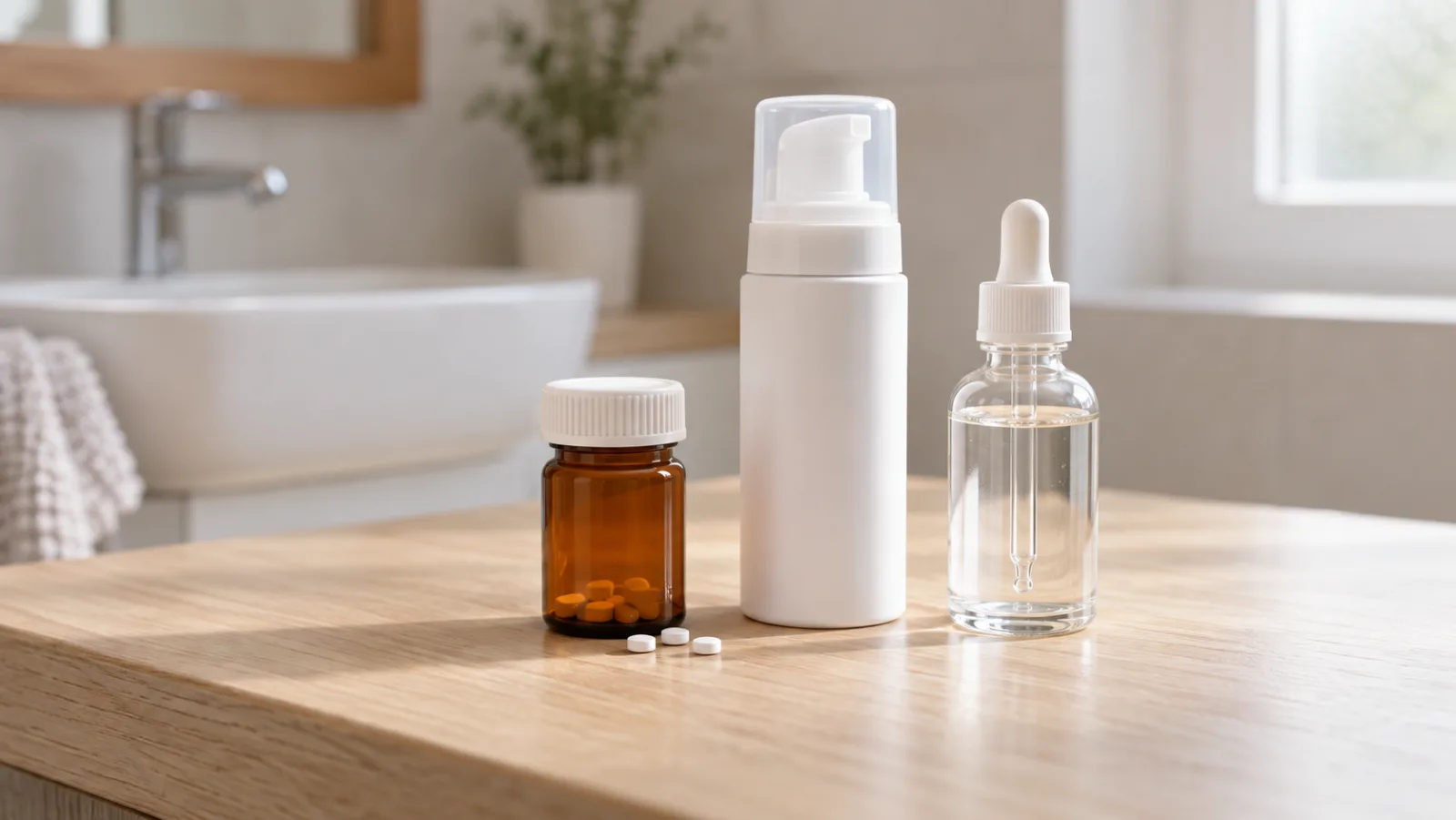
Oral minoxidil and topical minoxidil grew roughly the same amount of hair in the head-to-head trials, so doctors rarely choose between them on results. They choose on your blood pressure and heart history, how your scalp tolerates the liquid, how much stray body hair you would tolerate, and the unglamorous question of whether a foam will really get used every day for a year.
What the head-to-head trials found
Oral minoxidil did not outperform topical minoxidil in either of the two randomised comparisons most dermatologists cite. Penha and colleagues ran a double-blind trial in Brazil, published in JAMA Dermatology in 2024: men took 5 mg oral minoxidil daily with a placebo lotion, or applied 1 mL of 5% topical minoxidil twice daily with a placebo pill. Of 90 men enrolled, 68 finished the 24 weeks. Density gains were statistically indistinguishable. Photographs did favour the pill on the crown, though not at the front.
The women’s data point the same way. Ramos and colleagues, in a 2020 Journal of the American Academy of Dermatology trial, gave 52 women either 1 mg oral minoxidil or 5% topical solution once daily. After 24 weeks, total hair density rose 12% on the pill and 7.2% on the solution. Tempting gap. But the difference was not statistically significant, so it proves nothing on its own. Where the pill sits among every other option for women is laid out in hair loss treatments for women, ranked by evidence.
So the honest summary is boring: similar hair, different delivery. Weighing natural options too? Read our breakdown of the rosemary oil versus minoxidil trial first.
The pill is an old blood pressure drug
Oral minoxidil tablets are approved in the US to treat severe high blood pressure, not hair loss, and the label reads like it. The DailyMed label for minoxidil tablets carries a boxed warning that the drug “may produce serious adverse effects,” including pericardial effusion, occasionally progressing to tamponade, and worsening angina. It reserves the drug for hypertension that has not responded to maximum doses of a diuretic plus two other blood pressure medicines.
Context matters here. That label describes hypertension dosing: a 5 mg starting dose, a usual range of 10 to 40 mg a day, and tablets sold as 2.5 mg and 10 mg. The hair-loss trials above used 1 mg in women and 5 mg in men. Low-dose is not no-dose, though, and the label also lists pheochromocytoma as a contraindication. Oral minoxidil needs a prescriber who knows your history.

Side effects: body hair versus scalp itch
Oral minoxidil’s signature side effect is unwanted hair growth elsewhere, while topical minoxidil’s is an irritated scalp. In the 1,404-patient study by Vañó-Galván and colleagues (JAAD, 2021), hypertrichosis hit 15.1% of patients. Systemic effects were rarer: lightheadedness 1.7%, fluid retention 1.3%, a fast heartbeat 0.9%, headache 0.4%. Only 1.7% stopped because of side effects, and no life-threatening events were recorded. The authors note it was retrospective, with no control group.
At the higher 5 mg dose the picture changes. In the Penha trial, 22 of 45 men on oral minoxidil (49%) developed hypertrichosis and 6 of 45 (14%) reported headache, while heart rate and blood pressure changes did not differ from the topical group. Topical users have their own list, and we cover the shedding phase and propylene glycol itch in our guide to minoxidil side effects.
| Factor | Oral minoxidil | Topical minoxidil |
|---|---|---|
| FDA status for hair loss | Off-label; tablets are approved for severe hypertension | Approved over the counter |
| Head-to-head results | Not superior to topical at 24 weeks (Penha 2024, Ramos 2020) | Similar density gains in the same trials |
| Most common side effect | Unwanted body and facial hair, 15.1% at low dose (Vañó-Galván 2021) | Scalp itching and flaking, often from the propylene glycol vehicle |
| Daily routine | One tablet | Solution twice daily for men, foam once daily for women |
| Needs a prescription | Yes, plus a history and blood pressure check | No |
How a doctor actually decides
Oral minoxidil is framed as the alternative route, not the upgrade. Penha and colleagues end their JAMA Dermatology paper by calling low-dose oral minoxidil an option for patients who prefer oral therapy or cannot tolerate topical treatment. Put that next to the tablet label and the conversation with your doctor comes down to five questions:
- Is the diagnosis actually pattern hair loss? The topical Drug Facts label says not to use minoxidil for sudden or patchy loss, or loss with no known cause. Get that sorted first.
- What is your heart and blood pressure history? Given the tablet label’s boxed warning, this is where an oral prescription lives or dies.
- Has the liquid wrecked your scalp? Irritation that persists even on the foam is exactly the intolerance Penha and colleagues had in mind.
- Will you really apply it twice a day? A topical you skip half the week loses to a pill you take.
- How would you feel about fine hair on your forehead or arms? For some women especially, a 15% chance is a dealbreaker.
Our own view: if the foam is working and your scalp is calm, there is little reason to swap a well-tolerated OTC product for an off-label systemic drug. If you hate the ritual, the pill is a legitimate conversation to have with your doctor, not a hack. Women should also read what the minoxidil label allows for women, and anyone building a stack can compare every major hair loss treatment class first.
Questions people actually ask
Can I switch from topical to oral minoxidil on my own?
No. Oral minoxidil is a prescription drug whose tablet label carries a boxed warning about pericardial effusion and angina. A doctor needs your blood pressure, heart history and current medicines before prescribing it, and should decide the dose.
Will oral minoxidil lower my blood pressure?
It is a blood pressure drug, so the possibility is real. In the Penha 2024 trial at 5 mg, blood pressure and heart rate changes did not differ from the topical group, while the 2021 JAAD safety study recorded lightheadedness in 1.7% of patients. Report dizziness or swelling to your doctor promptly.
Can I use oral minoxidil with a laser cap?
People do combine treatments, but no trial we cite here tested that pairing. Check the device evidence in what the laser cap trials show, then run the plan past your dermatologist.
The pill is not a stronger minoxidil. It is the same drug by a different road, with a different set of trade-offs, and the right road depends on your body, not on what worked for someone on Reddit.