Hair Growth Serums: Which Ingredients Have Trial Data
Why you can trust this guide: myhair.health earns nothing on any serum named here, and a commission on some laser devices. Details are in our affiliate disclosure.
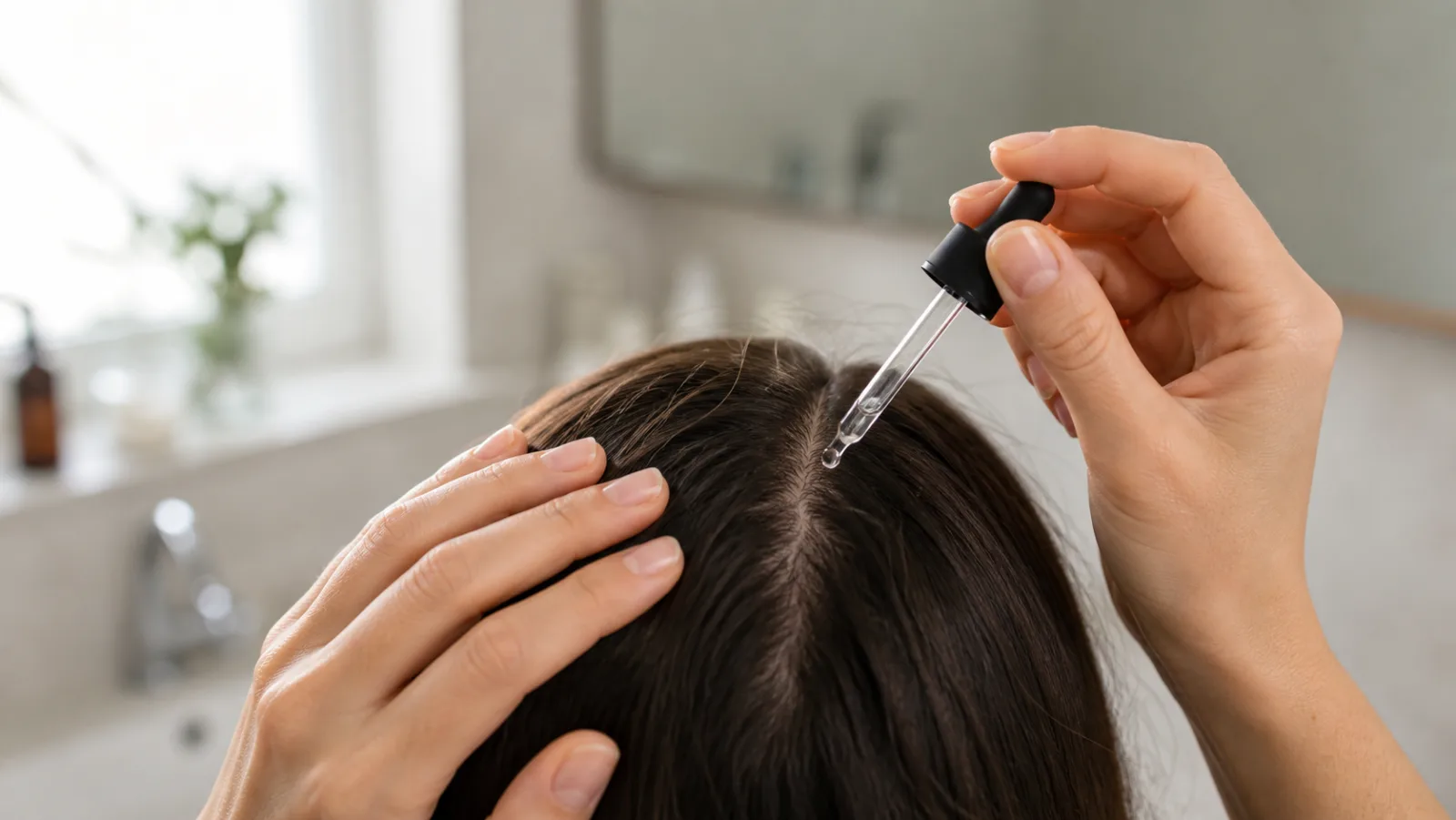
Only one hair growth serum ingredient has the full set of trial data behind it, and that is minoxidil. Caffeine and rosemary oil each have one randomized trial that held up against minoxidil. Everything else on the label, from Redensyl to copper peptides, rests on small company-run studies. That is the whole ranking. The rest of this page is the evidence behind it, so you can read a serum label and know what you are paying for.
What counts as trial data for a serum?
Trial data for a hair growth serum means a randomized study where real people used the ingredient for at least six months and someone counted the hairs. Not a petri dish. Not a survey where users say their hair feels thicker. The bar is a comparison group, either placebo or minoxidil, and a measurement like hair density per square centimetre or the share of hairs in the growing (anagen) phase. Hold every serum to that bar. Most do not clear it, and the marketing knows it.
Minoxidil: the benchmark every serum is measured against
Minoxidil is the ingredient the others get compared to, because it has the deepest trial record and the only FDA-approved over-the-counter label for regrowth. The Men’s Rogaine 5% label directs 1 mL on the scalp twice a day, says results may show at two months, and tells you to stop and ask a doctor if nothing regrows by month four. Our page on does minoxidil work walks through what the trials measured. It is not glamorous. It is just the drug that works.
One honest limit: minoxidil keeps working only while you keep using it, and the label says hair loss “will begin again” if you stop. Scalp irritation is the common complaint, covered on our minoxidil side effects page. If you are a woman, use a women’s product; the men’s 5% carton says so.
Caffeine: one trial, and it held
Caffeine is the one cosmetic serum ingredient with a head-to-head trial against 5% minoxidil that it did not lose. Dhurat and colleagues randomized 210 men with male pattern hair loss across five sites in India to a 0.2% caffeine liquid or 5% minoxidil solution for six months (Skin Pharmacology and Physiology, 2017). The anagen hair ratio improved 11.68% on minoxidil and 10.59% on caffeine, a gap of about one percentage point, within the margin the authors set for non-inferiority.
Now the caveats, because they matter. The trial was open-label, so everyone knew what they were using. Two of the authors worked for or consulted for the company that makes the caffeine product. And “not inferior” was judged on a trichogram, not on photos you would recognise as regrowth. I read it as a real result with a sponsor’s fingerprints on it. Good enough to try caffeine if minoxidil irritates your scalp. Not good enough to call them equals.
Rosemary oil: matched 2% minoxidil, not 5%
Rosemary oil matched minoxidil in a trial, but it was the 2% strength, and that detail gets dropped from every TikTok that quotes it. Panahi and colleagues randomized 100 people with androgenetic alopecia to rosemary oil or 2% minoxidil, twice daily for six months (Skinmed, 2015). Hair count rose in both groups and did not differ between them. The minoxidil group itched more. Our full breakdown is at rosemary oil vs minoxidil.
So rosemary oil has a trial, and a decent one. It was just measured against the weaker minoxidil, the one most men never buy. A serum that lists rosemary high on the ingredient list has something behind it. A serum that lists it last, after fragrance, has a story.
Serum ingredients compared
Hair growth serum ingredients line up like this when you ask the one question that matters: what did the trial compare it to, and who paid.
| Ingredient | Best trial | Compared with | What it showed | The catch |
|---|---|---|---|---|
| Minoxidil 5% | Multiple placebo-controlled trials; FDA OTC label | Placebo | Regrowth on the crown; results at 2 to 4 months per label | Stops working when you stop; scalp irritation |
| Caffeine 0.2% | Dhurat 2017, 210 men, 6 months | Minoxidil 5% | Anagen ratio +10.59% vs +11.68%, non-inferior | Open-label; sponsor’s staff among authors |
| Rosemary oil | Panahi 2015, 100 people, 6 months | Minoxidil 2% | Hair count rose equally in both groups | Beat the weak strength, not 5% |
| Capixyl 5% | 30 men, 4 months | Placebo | Anagen-to-telogen ratio +46% vs a 33% fall | Tiny, maker-linked, as reported in a 2025 review |
| Procapil 3% | 35 men, 4 months, pilot | Placebo | 67% of 18 treated men improved on anagen ratio | Pilot size; no minoxidil arm |
| Melatonin (topical) | Fischer 2012, five studies | No placebo in the clinical arms | Hair density +29% at 3 months in about half of 35 men | Pre-post design, so no control group |
| Copper peptides | Small topical studies | Mostly none | Reports of higher count, less shedding | No large randomized trial |
Sources: the Men’s Rogaine 5% drug facts label on DailyMed; Dhurat and colleagues, Skin Pharmacology and Physiology, 2017; Panahi and colleagues, Skinmed, 2015; Fischer and colleagues, International Journal of Trichology, 2012; Bikash, International Journal of Trichology, 2025. Download this table as CSV.
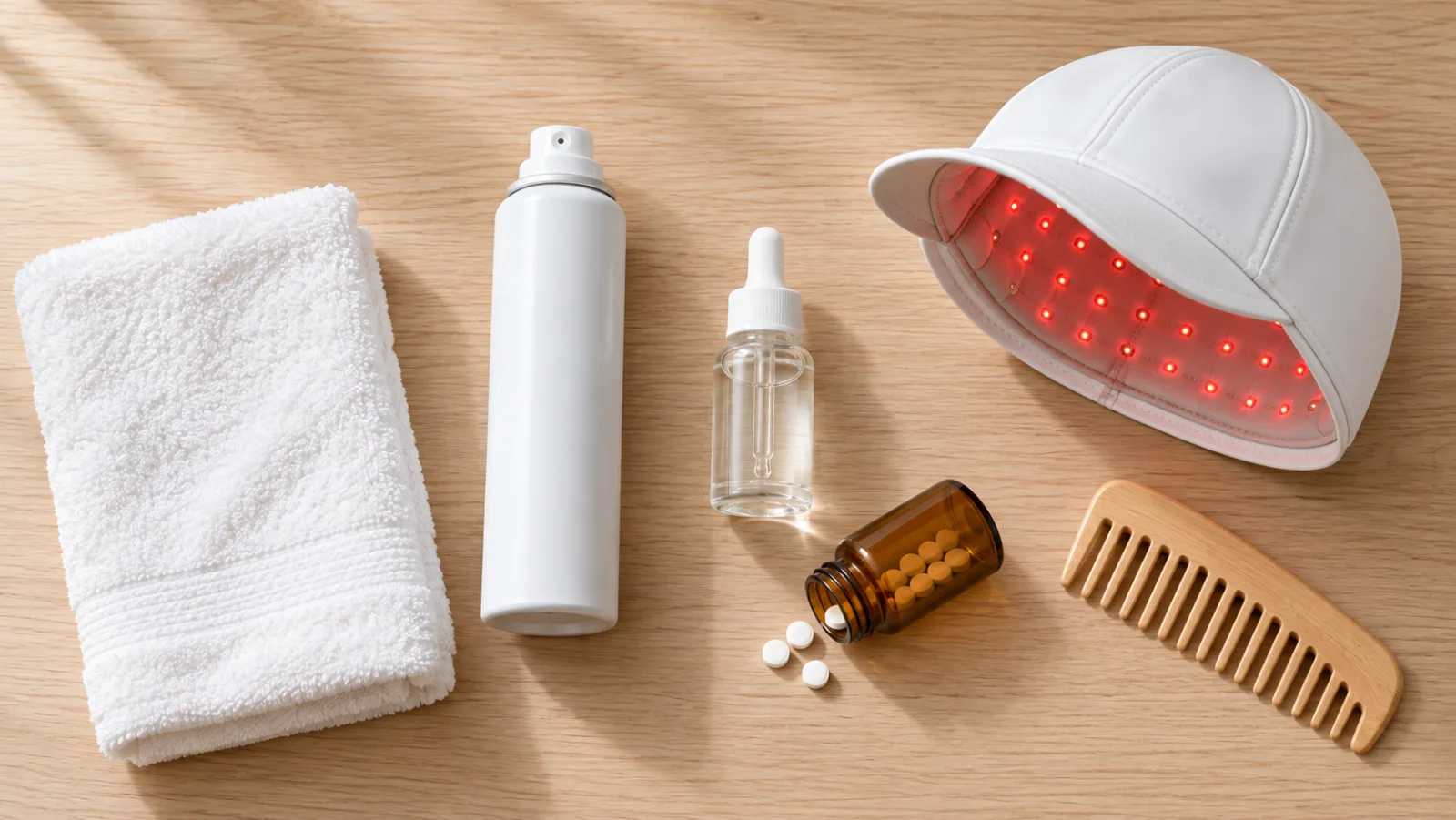
Redensyl, Capixyl, Procapil, melatonin and peptides
Redensyl, Capixyl and Procapil are trademarked blends whose evidence comes mostly from small studies run with the makers involved. A 2025 review by Chingshubam Bikash in the International Journal of Trichology lays it out: a 30-man Capixyl study, a 35-man Procapil pilot, and one 24-week trial of 106 men where all three combined outscored 5% minoxidil on researcher ratings. That last result sounds huge. Read it again. Three actives at once, so nobody can say which one did the work, and the review does not name who funded it. The same review flags small samples, missing comparisons and conflicts of interest across this whole category.
Topical melatonin is the odd one. Fischer and colleagues (International Journal of Trichology, 2012) reported five studies, including a 35-man TrichoScan study where about half the men gained 29% hair density at three months and 41% at six. The clinical studies were pre-post designs with no placebo group, so you cannot separate the melatonin from time and hope. Copper peptides sit in the same bracket, promising and unproven; our peptides for hair growth page explains why we call them a supporting act, not a lead.
How to read a serum label
Read a hair growth serum label by finding the active and its percentage first, then checking whether that exact pairing was ever trialled. Here is the checklist I use:
- Is minoxidil in it? If yes, it is a drug product and the label will say “Drug Facts”. If no, it is a cosmetic, and nothing on the box has been reviewed for regrowth.
- Is the trialled strength on the label? Caffeine was tested at 0.2%. Capixyl at 5%. A serum that hides the percentage is hiding something.
- Where in the list does the active sit? Ingredients run from most to least. Rosemary after fragrance is decoration.
- Who ran the study the brand cites? If the citation is the brand’s own website, treat it as a claim, not data.
- Does it match your pattern? Minoxidil’s label covers the crown, not a receding hairline. No serum has better data for the temples.
Thinning that is sudden, patchy or comes with scalp pain is a doctor’s job, not a serum’s. For the full ranking across drugs, devices and botanicals, see hair loss treatments compared. If you want a non-drug route with its own trial record, red light therapy for hair is the other one we cover.
Quick answers
What is the best ingredient for a hair growth serum?
Minoxidil, by evidence. It is the only topical regrowth ingredient with FDA over-the-counter labelling and placebo-controlled trials behind it. Caffeine 0.2% is the strongest non-drug option, with one trial showing it was not inferior to 5% minoxidil over six months.
Do hair serums actually work?
Serums with minoxidil work for crown thinning in most people who use them twice daily for at least four months, per the Rogaine label. Cosmetic serums without minoxidil range from one supporting trial (caffeine, rosemary oil) to none at all. Check the active and the percentage before you believe the box.
Is caffeine serum as good as minoxidil?
Close in one trial, with strings attached. Dhurat and colleagues (2017) found 0.2% caffeine non-inferior to 5% minoxidil in 210 men over six months, but the study was open-label and had the sponsor’s staff among the authors. Reasonable to try if minoxidil irritates you; not a proven equal.
How long before a hair growth serum shows results?
Four to six months, and every trial on this page ran that long. The minoxidil label says two months for some people and at least four for others. Judge any serum at month six with same-light photos, not at week three in the mirror.
Buy the ingredient, not the bottle. If it is not minoxidil, caffeine or rosemary, you are paying for a study that has not been run yet.