Minoxidil Side Effects: Shedding, Scalp Irritation and What Is Normal
Why you can trust us: myhair.health earns a commission if you buy through our links. That commission never changes our testing results or what we tell you the label says.

Minoxidil’s common side effects are local and fairly boring: an itchy or flaking scalp, and a temporary jump in shedding during the first weeks. The Drug Facts label saves its real warnings for a short list of body-wide signs, and that list is the part almost nobody reads.
The shedding phase, and how long it lasts
Minoxidil shedding is a measured, time-limited phase, not a sign the drug is wrecking your hair. Bi and colleagues, in the Journal of Dermatological Treatment in 2025, followed 49 patients with androgenetic alopecia on 2% or 5% topical minoxidil for 24 weeks, counting shed hairs every four weeks. The increase stayed inside the first 12 weeks, then settled. It ran longer in the 2% group than the 5%, and its severity tracked with how much their hair grading improved by the end.
That last detail is the interesting one: the people who shed harder did better. One retrospective study of 49 people does not make shedding a prophecy, but it does make it a documented event rather than forum folklore. The mechanism is unglamorous. Minoxidil pushes resting follicles back toward growth, and a restarting follicle evicts the old hair sitting in it first.
Be careful with the confident timelines, though. The Drug Facts panels on DailyMed for the men’s 5% solution and the women’s 5% foam describe no shedding phase at all, so a forum post promising weeks two through eight is not quoting the label. Photograph your part line on day one under the same bathroom light and repeat monthly. Those photos are also the only fair way to judge whether minoxidil works for you at all. For women choosing a strength, the label rules for the 2% solution and 5% foam differ more than the packaging suggests.
Scalp irritation is usually the vehicle
The itching, flaking and redness people blame on minoxidil is most often a reaction to propylene glycol, the solvent in the liquid version, rather than to minoxidil itself. BinJadeed and co-authors, in a 2021 Cureus case report, describe irritant contact dermatitis with itching and scaling as the most common side effect of topical minoxidil, usually an allergic reaction to propylene glycol. Their practical point: people allergic to propylene glycol can switch to the foam, while people sensitised to minoxidil itself are not candidates for the topical drug at all.
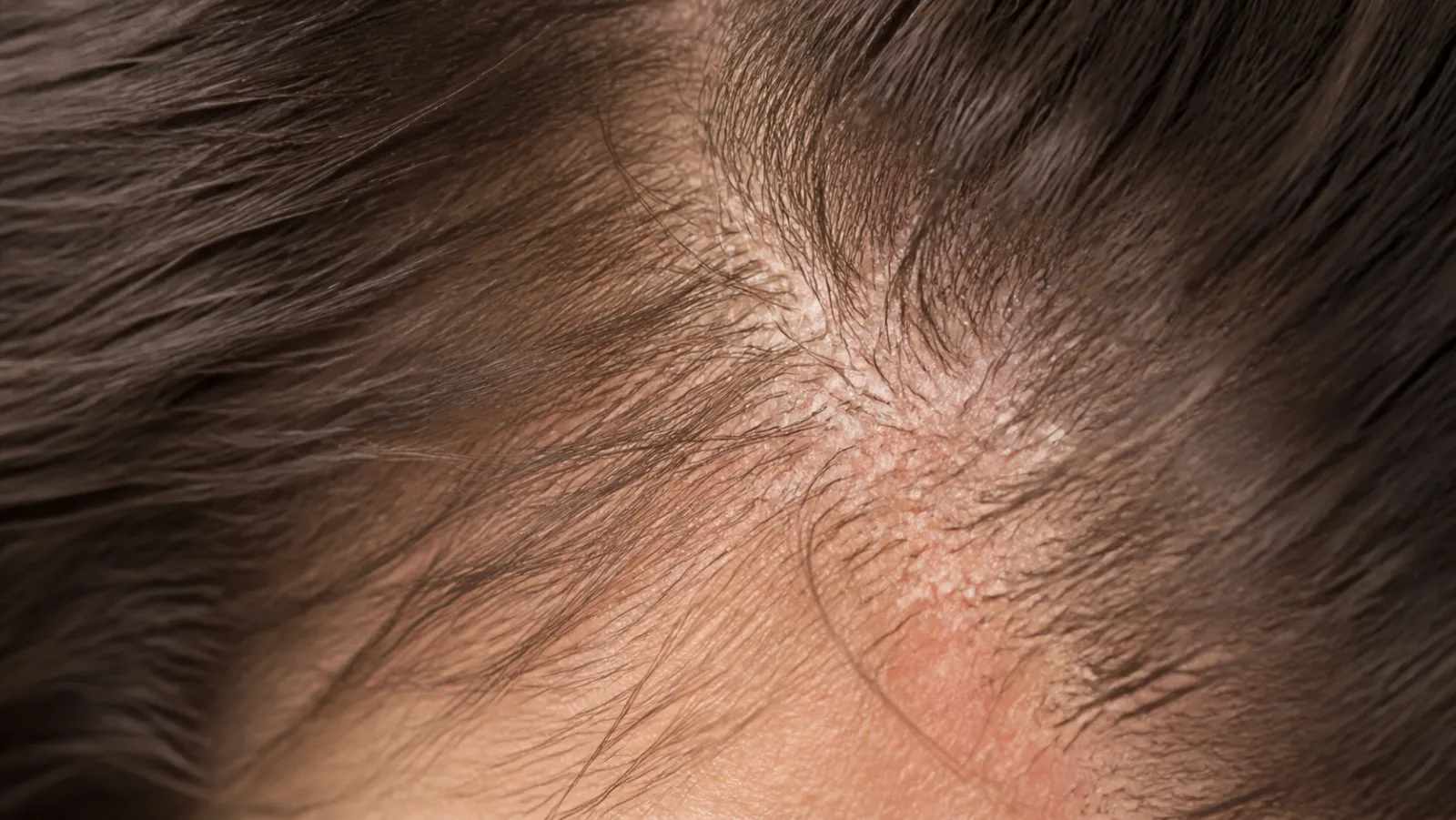
The trial evidence points the same way. Blume-Peytavi and colleagues randomised 113 women to once-daily 5% foam or twice-daily 2% solution for 24 weeks in the Journal of the American Academy of Dermatology in 2011 and reported significantly lower rates of local intolerance in the foam group, specifically in itching and dandruff. The foam they tested was propylene glycol free. If the liquid is making your scalp miserable, changing format is cheaper than quitting. Switching brand will not help here, because the generic and the brand-name 5% solutions share the same propylene glycol base, as our label-by-label Kirkland minoxidil comparison shows. And if even the foam fails, oral minoxidil versus topical is the next thing to raise with a doctor. One more thing not to do on an irritated scalp: run a derma roller over it. Our derma roller and scalp massage guide explains why minoxidil stays off the scalp on rolling day.
| What you notice | What the label or evidence says | Your move |
|---|---|---|
| More hair in the drain, weeks 1 to 12 | On neither Drug Facts panel; Bi et al. 2025 found the rise confined to the first 12 weeks | Keep going, photograph monthly, reassess at the checkpoint |
| Itching, flaking, dandruff-like scale | Most common topical side effect per BinJadeed et al. 2021, usually propylene glycol | Ask about the propylene-glycol-free foam, and about patch testing |
| Scalp irritation or redness | On the stop-use list of both labels | Stop and see a doctor |
| Hair colour or texture changing | Both labels state some people have experienced this | Not a stop signal alone, mention it at your next appointment |
| Chest pain, racing heart, dizziness, swelling, sudden weight gain | On the stop-use list of both labels | Stop and get medical attention |
The six signs the label says stop on
Both Drug Facts panels carry an identical stop-use list, short enough to memorise. Stop use and ask a doctor if chest pain, rapid heartbeat, faintness or dizziness occurs; if sudden, unexplained weight gain occurs; if your hands or feet swell; if scalp irritation or redness occurs; if unwanted facial hair growth occurs; or if you see no regrowth by the checkpoint, four months on the men’s twice-daily 5% solution and six months on the women’s once-daily 5% foam.
Look at the first three and the pattern is obvious. Chest pain, a racing heart, swollen ankles and sudden weight gain are cardiovascular and fluid signs, and both labels separately say to ask a doctor before use if you have heart disease. That warning is not decoration.
Unwanted facial hair
Unwanted facial hair growth has its own bullet on the stop-use list of both the men’s 5% solution and the women’s 5% foam, which tells you how often it comes up. The directions for the women’s foam say to massage the product into the scalp with your fingers, then wash your hands well. That instruction earns its place: minoxidil on your fingertips travels to your forehead and your pillowcase.
What is not a side effect at all
Some things people report as minoxidil side effects are really signs minoxidil should never have been started. Both labels say do not use it if your hair loss is sudden or patchy, if you do not know the reason for it, if you have no family history of hair loss, if your scalp is red, inflamed, infected, irritated or painful, or if you are under 18. The women’s foam label adds hair loss associated with childbirth.
Diffuse shedding after a birth, an illness or a crash diet is a different condition with a different course, and patchy loss in defined circles can be autoimmune. A dermatologist sorts that out in one appointment. If pattern loss is confirmed, we compare every major treatment class and what the evidence supports, including stacking microneedling on a topical. Our guide to thinning versus shedding lays out the signs that separate a temporary shed from pattern loss.
Questions people actually ask
Does shedding mean the minoxidil is working?
Possibly, but do not bet a year on it. In Bi and colleagues’ 2025 study, shedding severity was significantly associated with improvement in hair grading in both the 2% and 5% groups. That is one retrospective cohort of 49 people, and plenty improve without a dramatic shed.
Should I push through scalp irritation or stop?
The Drug Facts panels are unambiguous: scalp irritation or redness is on the stop-use list for both the 5% solution and the 5% foam. Stop and see a doctor. If propylene glycol turns out to be the culprit, the foam is the obvious thing to raise with your clinician. If minoxidil is off the table in any form, our comparison of red light therapy vs minoxidil covers the main drug-free option and what it costs.
Can I use minoxidil if I already have dandruff?
Not on an inflamed scalp. Both labels say do not use if your scalp is red, inflamed, infected, irritated or painful. Treat the scalp condition first, or you will never work out later which product is causing what.
Will applying more make results come faster?
No, and the directions say so outright: using more or more often will not improve results. The labelled doses are 1 mL of solution twice a day and half a capful of foam once a day. To add something instead, start with what the laser cap trials show and how we evaluate these devices.
Nearly everything on the common side effect list is local, reversible and often fixed by changing format. The six on the stop-use list are a different category, and there the right move is to put the bottle down and pick up the phone.