Minoxidil for Women: What the Label Allows and What Results Look Like
Why you can trust us: myhair.health earns a commission if you buy through our links. That commission never changes our testing results or what we tell you the label says.
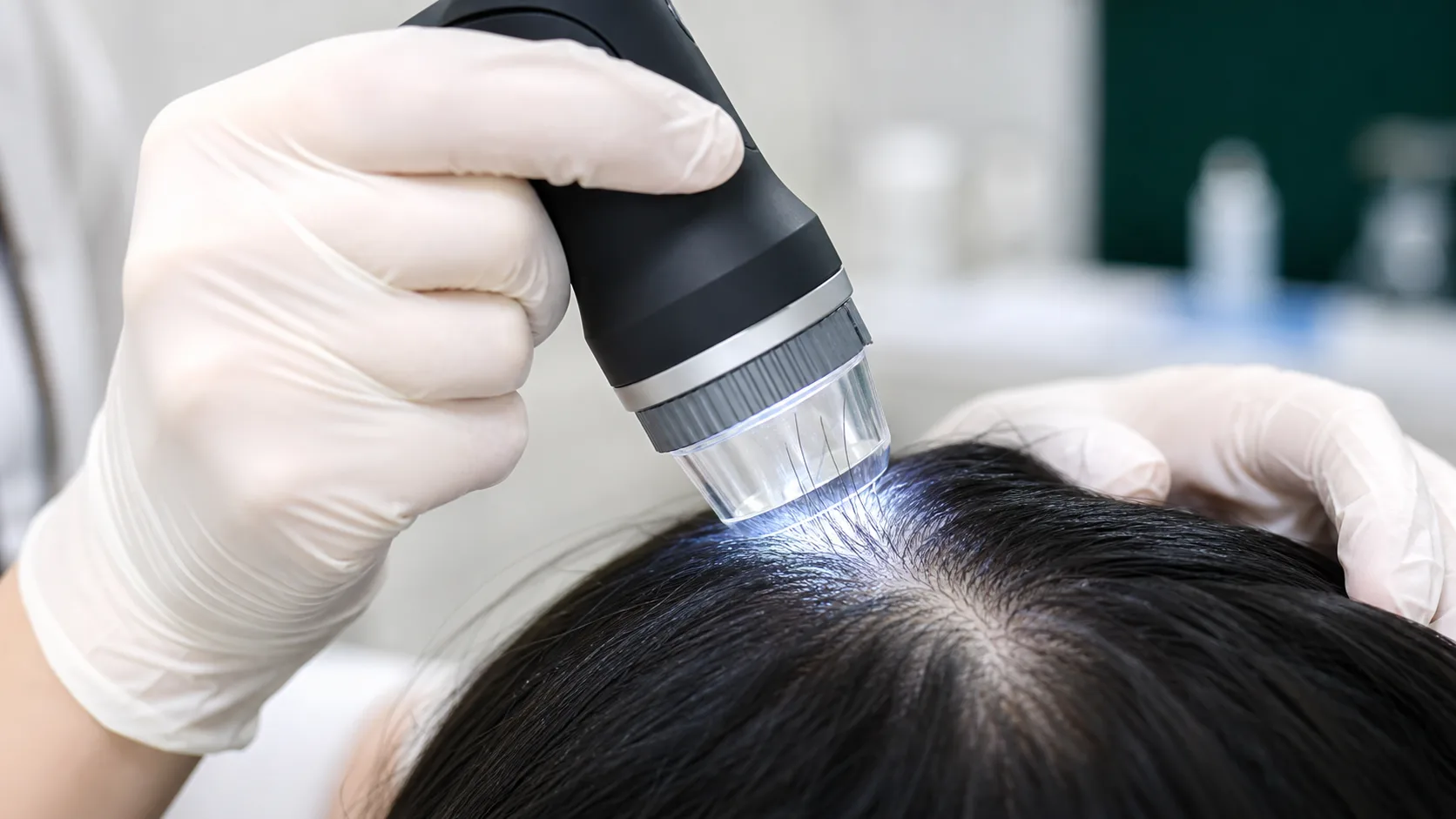
Minoxidil is the only over-the-counter drug approved for hair regrowth in women, and its label is much narrower than the marketing around it. Two versions are sold to women: 2% topical solution twice a day, and 5% foam once a day. Both target gradual thinning on the top of the scalp, both are for adults, and both stop working when you stop using them.
What the label actually allows for women
The minoxidil Drug Facts label allows women exactly two things: 1 mL of 2% topical solution applied with the dropper twice a day, or half a capful of 5% foam once a day, both directly onto the scalp in the thinning area. The labels published on DailyMed set the use as regrowing hair on the top of the scalp, with the 2% solution label specifying the vertex and pointing you to the diagram on the carton. You must be 18 or over. The oral minoxidil that dermatologists sometimes prescribe is a different conversation, with a different risk profile, held with a doctor; we lay out how oral and topical minoxidil compare in the trials.
Two details get ignored constantly. Both labels say do not use more than directed, and more product does not buy faster hair, it buys an irritated scalp. And minoxidil goes on the scalp, not on the hair. If you are massaging it through your lengths, you are treating your ends and paying for it.
2% solution or 5% foam?
For most women the 5% foam is easier to stick with, and the evidence says you are not trading away results for that convenience. Blume-Peytavi and colleagues randomized 113 women to 5% foam once daily or 2% solution twice daily for 24 weeks in the Journal of the American Academy of Dermatology in 2011, and reported the once-daily foam noninferior to the twice-daily solution for stimulating hair growth, with significantly lower rates of local intolerance and fewer complaints about styling. One trial is one trial. But adherence is where topicals die, and a once-a-day product you use beats a twice-a-day product you skip.
| 2% minoxidil solution | 5% minoxidil foam | |
|---|---|---|
| Dose per the label | 1 mL with the dropper | Half a capful |
| Frequency | Twice a day | Once a day |
| Where | Scalp, vertex per the carton diagram | Scalp, in the hair loss area |
| Label timeline | At least 4 months before results | Results may occur at 3 months, some women need 6 |
| Label says stop and see a doctor if | No regrowth in 4 months | No regrowth in 6 months |
| Cosmetic downside | Wet application, can affect styling | Dries fast, needs application to a dry scalp |
What results actually look like
Minoxidil regrowth in women looks like a part line that closes up, not a hairline that moves. The drug pushes miniaturized follicles back toward producing thicker, longer hairs, so the visible change is density in the area you treated. Your ponytail may feel fuller. Your scalp may show through less under bathroom lighting. A receded temple filling back in is not on the menu, and any before-and-after suggesting otherwise deserves suspicion.

The honest timeline is slower than the box implies, and the label agrees. Three to four months is the earliest checkpoint, six months is where the 5% foam label expects a verdict. Take a photo of your part on day one, under the same light, and repeat it monthly. You will not see change day to day, and memory is a terrible measuring instrument.
Two label statements are worth reading twice. First: the amount of regrowth differs for each person, and the product will not work for all women. Second: continued use is necessary to keep your regrowth, or hair loss will begin again. Minoxidil is a subscription, not a cure. The three trials behind that label, and what they actually counted, are in our look at whether minoxidil works. If daily application for years is not something you want, look at the other treatment classes before you start, not after.
When minoxidil is the wrong tool
The label itself tells you when not to use minoxidil, and the do-not-use list is specific. Per the Drug Facts panels for both the women’s 2% solution and the 5% foam, do not use it if:
- your hair loss is sudden or patchy
- your hair loss is associated with childbirth
- you do not know the reason for your hair loss
- you have no family history of hair loss
- your degree of loss is different from what the carton diagram shows
- you are under 18
The labels also state that minoxidil may be harmful if used when pregnant or breast-feeding, tell you to ask a doctor first if you have heart disease, and tell you to stop and see a doctor if chest pain, rapid heartbeat, faintness or dizziness occurs, or if your hands or feet swell. That list exists because diffuse shedding after a baby, an illness or a crash diet is usually a different condition that resolves on its own, and patchy loss can be autoimmune. Get the diagnosis first. If pattern thinning is confirmed and you want to stack something onto minoxidil, microneedling has the better supporting evidence, and rosemary oil is the gentler comparison people ask about next.
Questions women actually ask
Can women use the 5% minoxidil sold to men?
Women have their own approved 5% product, the once-daily foam, so there is no need to borrow the men’s version. The men’s 5% solution is labelled for twice-daily use in men, and going outside a product’s labelled population is a question for your doctor.
Is shedding in the first weeks normal?
The Drug Facts panels for the women’s 2% solution and the 5% foam do not describe an initial shedding phase, so treat any confident number you read about it as unverified. The label’s rule still applies: if your loss turns sudden or patchy, or you see no regrowth by the checkpoint, stop and see a doctor. The trial data on the shedding phase, along with the rest of the side effect picture, is covered in our guide to minoxidil side effects and what counts as normal.
What happens if I stop using it?
The 2% solution label answers this directly: continued use is necessary to keep your regrowth, or hair loss will begin again. Expect the treated area to drift back toward its untreated trajectory.
Can I combine minoxidil with a laser cap?
Minoxidil and low-level laser devices work through different mechanisms and are commonly used together, though few trials test the combination head to head. If you are weighing the device side, start with what the laser cap trials show and how we evaluate these devices.
One last thing, and it matters more than the strength you pick: a dermatologist can tell you in ten minutes whether you have pattern loss at all. That appointment saves more wasted months than any product choice on this page. If minoxidil turns out not to be enough, our ranking of hair loss treatments for women shows what usually comes next.