Red Light Therapy for Hair Growth: What the Research Shows
Red light therapy produced a mean gain of about 25 hairs per square centimetre over 48 weeks in a published helmet trial. Here is who it works for.
Red light therapy for hair growth is one of the few non-drug hair treatments with genuine randomised trial evidence behind it, and its effect is real, modest, slow, and strictly limited to follicles that are still alive. That combination is what most coverage of this topic gets wrong in one direction or the other. This page sets out what the published research actually found, in numbers.
How red light therapy affects a hair follicle
Red light therapy works on hair through photobiomodulation: light in the red part of the spectrum, typically around 650 nanometres, penetrates the scalp and is absorbed by chromophores inside follicle cells, principally cytochrome c oxidase in the mitochondria. That absorption is thought to increase ATP production, the cell’s energy currency, and to shift follicles out of the resting telogen phase and back into anagen, the active growing phase.
The practical translation: red light therapy does not create hair follicles. It attempts to restart follicles that are miniaturising but still present. Everything about who this therapy helps follows from that single fact.
The clinical evidence, with numbers
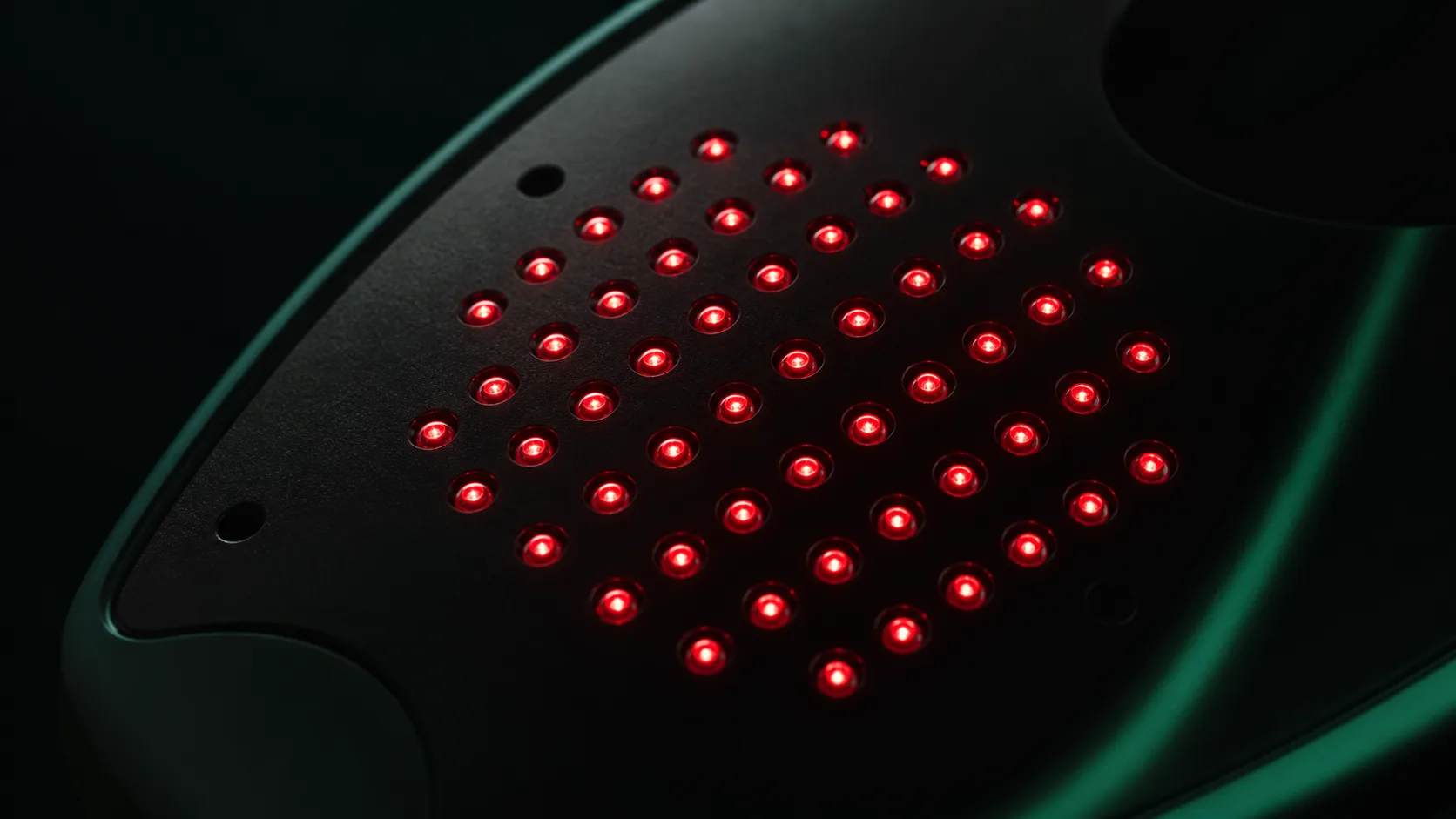
In a 12-month prospective trial published in Dermatologic Therapy, participants using a helmet-type red-light device (646-675 nm) three times a week for 20 minutes went from a mean hair density of 99.2 hairs/cm² at baseline to 124.2 hairs/cm² at week 48, a mean gain of about 25 hairs per square centimetre, with hair shaft thickness rising roughly 15%. This is the most useful single figure in the field because it comes from a realistic timeframe with a realistic device.
A 16-week multicentre, randomised, double-blind, sham-device-controlled trial provides the strongest causal evidence. The treated group gained 41.9 hairs/cm²; the sham group gained 0.72 hairs/cm². The sham arm is the crucial detail, those participants wore an identical-looking device that emitted no therapeutic light, followed the same routine, and held the same expectations. They saw essentially nothing. The light, not the ritual, produced the result.
A separate randomised, double-blind study using 650 nm light three times weekly for 24 weeks found greater hair coverage in the treated scalp (14.2%) than under sham treatment (11.8%). Again: a real difference, and a modest one.
Low-level laser therapy has been FDA-cleared for androgenetic alopecia since 2007. Clearance is a statement about safety and substantial equivalence to an existing device, it is not a promise of efficacy for any individual.
Sham device identical, inert
+2 to +9 hairs/cm²
Real laser device 26 weeks
+18 to +26 hairs/cm²
The real device grew roughly four times the terminal hair count of the sham over 26 weeks.
These are matched arms of a single double-blind, sham-controlled trial (Jimenez et al., 2014), not two studies spliced together. Every real-device model beat its matched sham, and every difference was statistically significant.
We do not publish before-and-after photographs. A photo taken under different lighting six months apart proves nothing, and every brand in this category knows it. These are measured terminal-hair counts from one published trial, not our customers and not our claims.
What the evidence does not show
The trials above do not show that red light therapy regrows hair on a bald scalp. They recruited people with pattern hair loss who still had follicles to stimulate, and that is the population in which the gains appeared.
They also do not show that the results are permanent. Photobiomodulation maintains and stimulates follicles for as long as it is applied; the gains diminish once treatment stops. Red light therapy is a maintenance commitment, not a cure, which is why the honest way to price a $2,699 device is over years, not as a one-off.
And they do not show that more diodes produce more hair. The evidence supports the therapy. It does not establish that a 500-emitter helmet outperforms an 80-laser one, which is exactly why we tell readers not to pay a premium for a bigger number on a spec sheet.
Who red light therapy works for
Red light therapy is most likely to help you if you are in the early or middle stages of pattern hair loss, your thinning areas still have visible fine or miniaturising hairs, and you are prepared to treat three times a week indefinitely. It is most likely to disappoint you if your scalp is smooth and shiny where the hair has gone, or if your realistic answer to “will you still be doing this in eight months?” is no.
Choosing a red light device for hair
At-home devices range from about $200 for a laser comb to $2,699 for the iRestore Elite. The price gap does not reflect a gap in the underlying therapy, it reflects coverage, form factor, and light source. We break down the whole field, with real prices, in our laser cap comparison.
For the deeper mechanism, see low-level laser therapy explained and does laser hair growth work. If you have narrowed it down to iRestore, read our evidence-led iRestore review before spending anything.
Does red light therapy help hair growth?
Yes, modestly. Randomised sham-controlled trials of red-light helmet devices show real hair-count gains, 41.9 hairs/cm² versus 0.72 in the sham group over 16 weeks in one study, but only in people who still have living follicles in the treatment area.
How often should you use red light therapy for hair?
Three times a week is the cadence used in the trials that produced positive results, with sessions of roughly 20 to 25 minutes. More frequent use has no evidence base behind it and is not known to accelerate results.
Is red light therapy for hair safe?
Low-level laser therapy has a strong safety record and has held FDA clearance for androgenetic alopecia since 2007. It is non-thermal, non-invasive, and carries none of the systemic side-effect risk associated with drug treatments like finasteride.
Can red light therapy regrow a bald spot?
No. Red light stimulates follicles that are weakened but alive. A scalp area that is completely bald, smooth, with no fine hairs, no longer has the follicles for the therapy to act on, and no device on the market changes that.