Low-Level Laser Therapy (LLLT) for Hair: The Mechanism, Explained
LLLT has been FDA-cleared for androgenetic alopecia since 2007. Here is the mechanism, the wavelength that matters, and what "low-level" actually means.
Low-level laser therapy is the clinical name for what every laser cap, helmet and comb on the market is doing, and understanding the mechanism is the fastest way to see through the marketing around these devices. LLLT has held FDA clearance for androgenetic alopecia since 2007, and it is the therapy, not any particular brand, that the published evidence supports.
What “low-level” actually means
Low-level laser therapy uses light at an intensity too low to heat or damage tissue. That is the entire distinction from the lasers used in hair removal, which work precisely by delivering enough thermal energy to destroy the follicle. LLLT does the opposite: it deposits energy gently enough to change how a cell behaves without harming it. The term for this is photobiomodulation.
This is why LLLT devices are safe for repeated home use and why they carry none of the systemic side-effect profile that comes with drugs like finasteride. It is also why they are slow, a therapy that nudges cellular behaviour works on a biological timescale, not a cosmetic one.
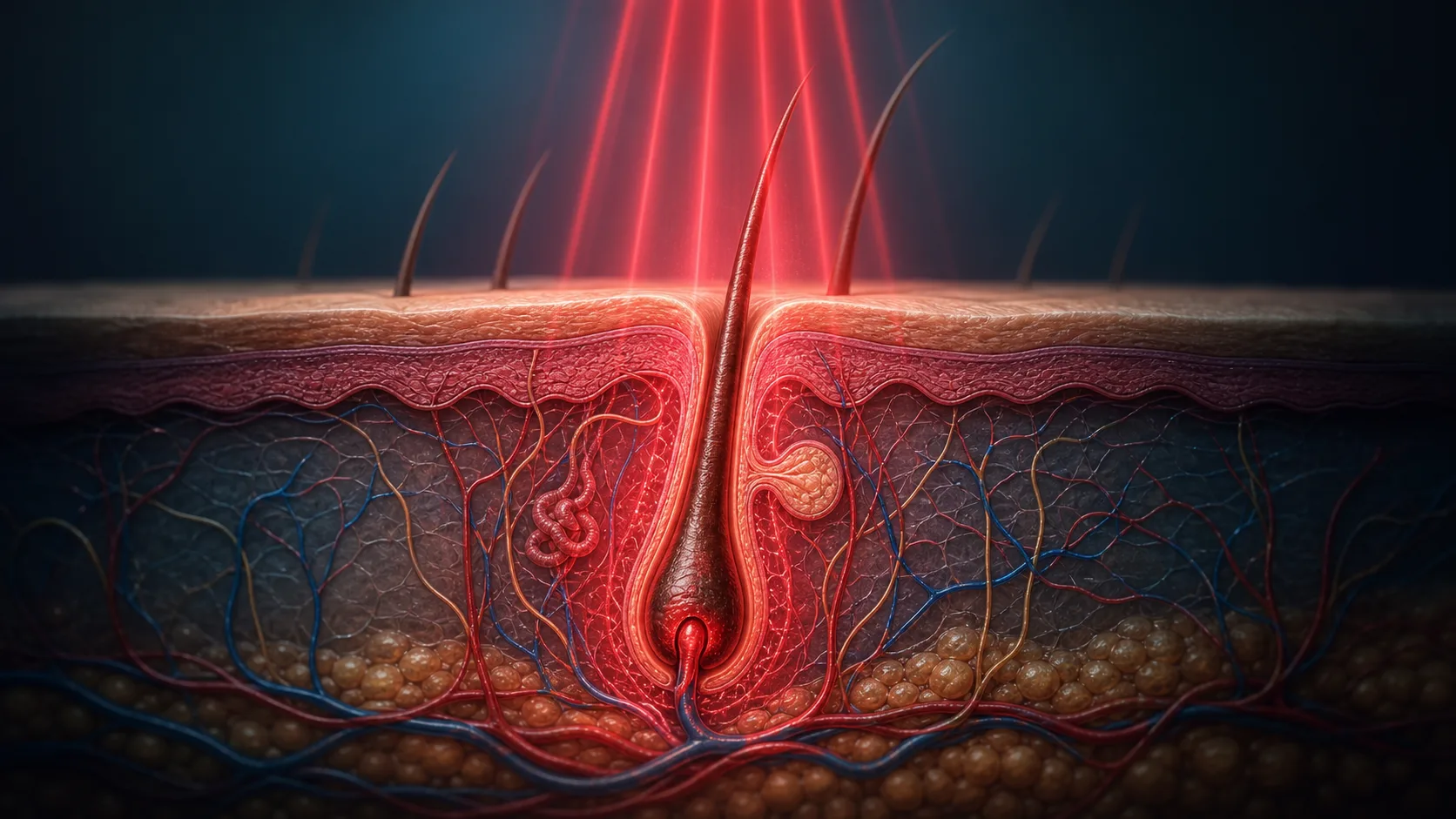
The mechanism, step by step
Red light at roughly 650 nanometres penetrates the scalp and reaches the hair follicle. There it is absorbed by cytochrome c oxidase, an enzyme in the mitochondria, the structures that produce cellular energy. That absorption is thought to increase production of ATP, the cell’s energy currency, and to trigger downstream signalling that pushes follicles out of the resting telogen phase and into anagen, the active growth phase.
The consequence of this mechanism is the single most important limit on the whole device category: LLLT acts on follicles that exist. It energises weakened, miniaturising follicles. It cannot regenerate follicles that have been lost, because there is nothing left for the light to act on.
Why 650 nanometres?
The therapeutic window for LLLT in hair sits in the red part of the spectrum, broadly 630-680 nm, with 650 nm the most commonly cited target. This range is where light penetrates tissue effectively while still being absorbed by the target chromophores. Devices that emit outside this window have a weaker theoretical basis, whatever their marketing says, the wavelength is not a cosmetic detail, it is the mechanism.
The trial evidence for LLLT
The strongest causal evidence comes from a 16-week multicentre, randomised, double-blind, sham-device-controlled trial of a helmet-type LLLT device: the treated group gained 41.9 hairs/cm² while the sham group gained 0.72 hairs/cm². The sham participants wore an identical inert device on the same schedule and saw essentially no change.
Over a longer horizon, a 12-month prospective trial of a red-light helmet (646-675 nm, three times weekly, 20 minutes) recorded mean hair density rising from 99.2 to 124.2 hairs/cm² at 48 weeks, a gain of about 25 hairs/cm², alongside a roughly 15% increase in hair shaft thickness. A separate 24-week randomised double-blind study at 650 nm found 14.2% hair coverage in the treated scalp against 11.8% under sham.
Taken together: LLLT produces a real, replicable, modest improvement in hair density in people with pattern hair loss. It is one of the better-evidenced non-drug options available, and it is not a cure.
Lasers versus LEDs
Some devices use pure laser diodes; others mix lasers with LEDs; some use LEDs alone. The theoretical argument for lasers is that coherent light penetrates more efficiently. The counter-argument is that what matters is the right wavelength arriving at the follicle with sufficient energy, which a well-designed LED array can also achieve. Published helmet trials have shown positive results with both formats, and the literature does not currently declare a winner.
The practical takeaway is to read emitter counts carefully rather than dismissing them. A device advertising 500 mixed laser-and-LED emitters is not delivering six times the biological effect of one with 80 pure lasers, but it is putting light on considerably more of your scalp, and follicles outside the treated area get nothing at all. See our iRestore vs Theradome comparison for what that trade actually costs.
Is low-level laser therapy the same as red light therapy?
Effectively yes, in the hair-loss context. LLLT is the clinical term and typically implies laser diodes; 'red light therapy' is the consumer term and covers both laser and LED devices. Both rely on photobiomodulation at similar wavelengths.
How often do you need LLLT for hair?
Three times a week, for 20 to 25 minutes, indefinitely. That is the cadence used in the trials that produced positive hair-count results, and the benefits diminish once treatment stops.
Does LLLT have side effects?
LLLT has a strong safety record and is non-thermal and non-invasive. It carries none of the systemic side-effect risk associated with oral drug treatments for hair loss, which is a large part of its appeal.
Is LLLT worth the money?
It depends entirely on your stage of hair loss and your consistency. LLLT devices range from about $200 for a laser comb to $2,699 for the iRestore Elite, and the therapy only works on living follicles used relentlessly over months.
To see how this science translates into devices and prices, read our laser cap comparison or the red light therapy for hair growth overview.