Red Light Therapy vs Minoxidil: Evidence, Devices and Cost
Why you can trust us: myhair.health earns a commission on some laser devices, including iRestore, and nothing on minoxidil. Read the cost section with that in mind.
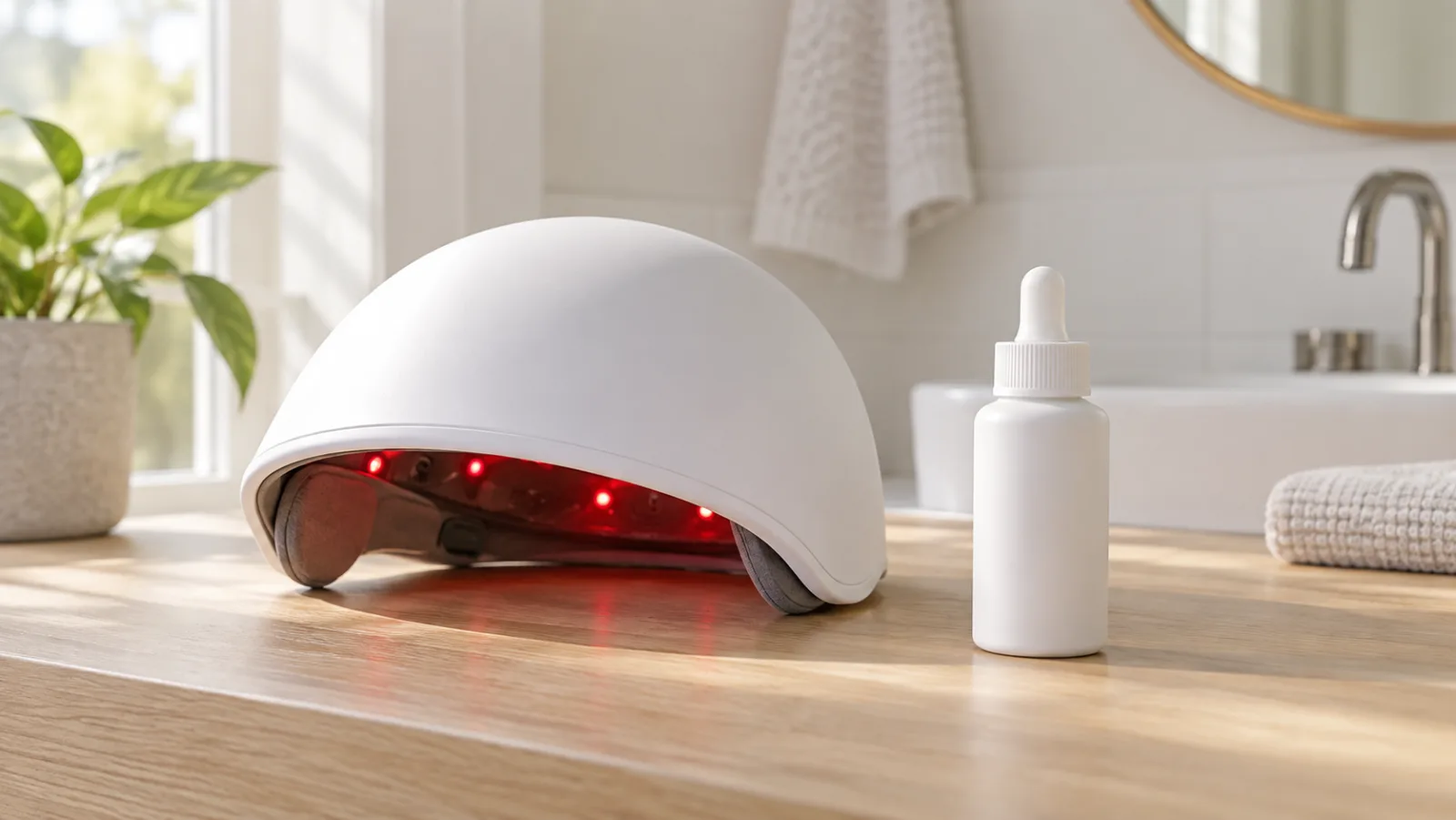
Red light therapy and minoxidil performed about the same in the two head-to-head trials I could find, but minoxidil costs far less to start and has the longer track record, so it is the sensible first move for most people with pattern hair loss. Red light earns its place when your scalp will not tolerate minoxidil, or when you want to stack it on top. Whether stacking helps is still argued over. You will see both sides.
What the head-to-head trials found
Red light therapy matched 5% minoxidil in the only two randomised head-to-head trials I found on PubMed, and both are small. In the larger one, published by Neema and colleagues in the Medical Journal Armed Forces India (2025), 91 men used either twice-daily 5% minoxidil or 10-minute sessions of 633 nm light three times a week. After six months, mean hair density rose from 97.6 to 134.6 with minoxidil and from 104.8 to 130 with light. The difference between groups was not significant.
One layer down, minoxidil edges ahead: 28.9% of that group showed excellent growth against 16.2% with light. With only 75 men finishing, that is a hint, not a verdict.
The 2017 trial by Esmat and colleagues in Lasers in Surgery and Medicine split 45 women with female pattern hair loss three ways for four months: minoxidil, an iGrow helmet for 25 minutes three times a week, or both. Light and minoxidil were comparable, and the combination scored best on Ludwig grade and satisfaction.
Does using both beat minoxidil alone?
Adding red light therapy to minoxidil may give a modest extra gain, but two 2025 meta-analyses asked exactly this and landed on opposite sides.
- No added benefit: Alosaimi and colleagues (Journal of Dermatological Treatment) pooled 4 randomised trials and found no significant difference in hair count (mean difference -0.04).
- A real bonus: Mawu and colleagues (Lasers in Medical Science) pooled 7 randomised trials and found higher hair density with the combination (mean difference 6.62), 1.71 times the satisfaction rate, and no extra side effects.
My read: the bigger pool leans toward a small, real bonus. Small matters when the bonus costs a thousand dollars.
What each option costs in money and time
Minoxidil is the cheap habit and a laser device is the expensive purchase, and time is the cost people forget to count. The Drug Facts label for men’s 5% minoxidil solution on DailyMed directs 1 mL twice a day, 14 applications a week. Device prices below come from our ranking of laser caps, last verified in July 2026, so check before you buy.
| Option | Up front | Keeps costing you | Your time | Hands-free |
|---|---|---|---|---|
| Minoxidil 5% solution (men’s label) | No device | Refills, indefinitely | 1 mL, twice a day | Not applicable |
| HairMax LaserBand 82 | $849 | Nothing after purchase | About 90 seconds a session | No |
| Theradome PRO LH80 | $995 | Nothing after purchase | Per the manual | Yes |
| iRestore Professional | $1,499 | Nothing after purchase | About 25 minutes, 3 times a week | Yes |
| iRestore Elite | $2,699 | Nothing after purchase | About 25 minutes, 3 times a week | Yes |
Download this table as a CSV file.
To price the choice, divide the device price by what you spend on minoxidil in a year. That is how many years the device must keep working to break even on money alone. Use your own receipt; our Kirkland minoxidil comparison shows how far a generic can shrink it.
Both share one catch. The minoxidil label warns you will lose newly regrown hair 3 to 4 months after stopping, and red light gains fade too once sessions stop. Neither is a course you finish.

If you add light, pick the format you will stick with. A hands-free helmet like the Theradome or iRestore asks you to sit for a while; the HairMax band is done in about 90 seconds but lives in your hand. How red light acts on a follicle is explained separately.
Which one to start with
Start with minoxidil if its label fits you, because it is the cheaper way to learn whether your follicles still respond, and its trial record runs deeper. Adil and Godwin’s 2017 meta-analysis in the Journal of the American Academy of Dermatology found minoxidil, finasteride and low-level laser all beat placebo in men, and noted that minoxidil is FDA-approved while the HairMax LaserComb is FDA-cleared.
Put light first if minoxidil irritates your scalp (see what normal irritation looks like) or a twice-daily ritual will not survive your mornings. Women should read what the women’s label allows, since the men’s 5% solution says “For use by men only.” And if your loss is sudden, patchy or unexplained, the minoxidil label lists that as a reason not to use it. See a doctor before you spend money on either.
Questions people actually ask
Should I use minoxidil before or after red light therapy?
No trial I found tested the order. The practical answer: run the light session on a clean, dry scalp and apply minoxidil afterwards, so the solution is not wiping onto the inside of the device. Your device manual has the final word.
Can red light therapy replace minoxidil?
For some people. In the 2025 Neema trial, light alone raised hair density about as much as minoxidil, but fewer men reached excellent growth. If minoxidil already works for you, there is no evidence-based reason to swap.
How long before I know if it is working?
Give either six months. The minoxidil label says results may appear at 2 months, and some men need at least 4. The light trials above measured at four and six months.
Do I need a prescription for either?
No. Topical 5% minoxidil is sold over the counter, and the laser devices in our ranking are sold directly to consumers. A dermatologist is still worth seeing if you are unsure your hair loss is the pattern kind.
Red light therapy is not a fancier minoxidil. It is a different bet with a bigger entry fee, and the evidence puts it in the same neighbourhood. Start with the cheaper test and let six months of photos, not a sales page, decide whether light joins your routine.