iRestore vs Omnilux: They Are Not Actually Competitors
Omnilux is built for skin, iRestore for hair. People compare them constantly. Here is which device does what, and why the comparison misleads buyers.
Why you can trust us: myhair.health earns a commission if you buy through our links. That commission never changes our testing results or which device we recommend.
iRestore and Omnilux are frequently compared and they are not really competitors: iRestore is a hair device and Omnilux is fundamentally a skin brand. Google’s own “People also ask” box pairs them constantly, which tells you the confusion is widespread, so it is worth settling clearly, because buying the wrong one is an expensive mistake.
What each device is actually for
| iRestore | Omnilux | |
|---|---|---|
| Primary target | Scalp hair (androgenetic alopecia) | Skin, wrinkles, tone, acne |
| Light source | Laser diodes + LEDs | LEDs |
| Form factor | Rigid scalp helmet | Flexible face and body masks |
| FDA clearance for hair loss | Yes | Not its indication |
| Price | $799-$2,699 | Skin-device pricing |
Why the comparison exists at all
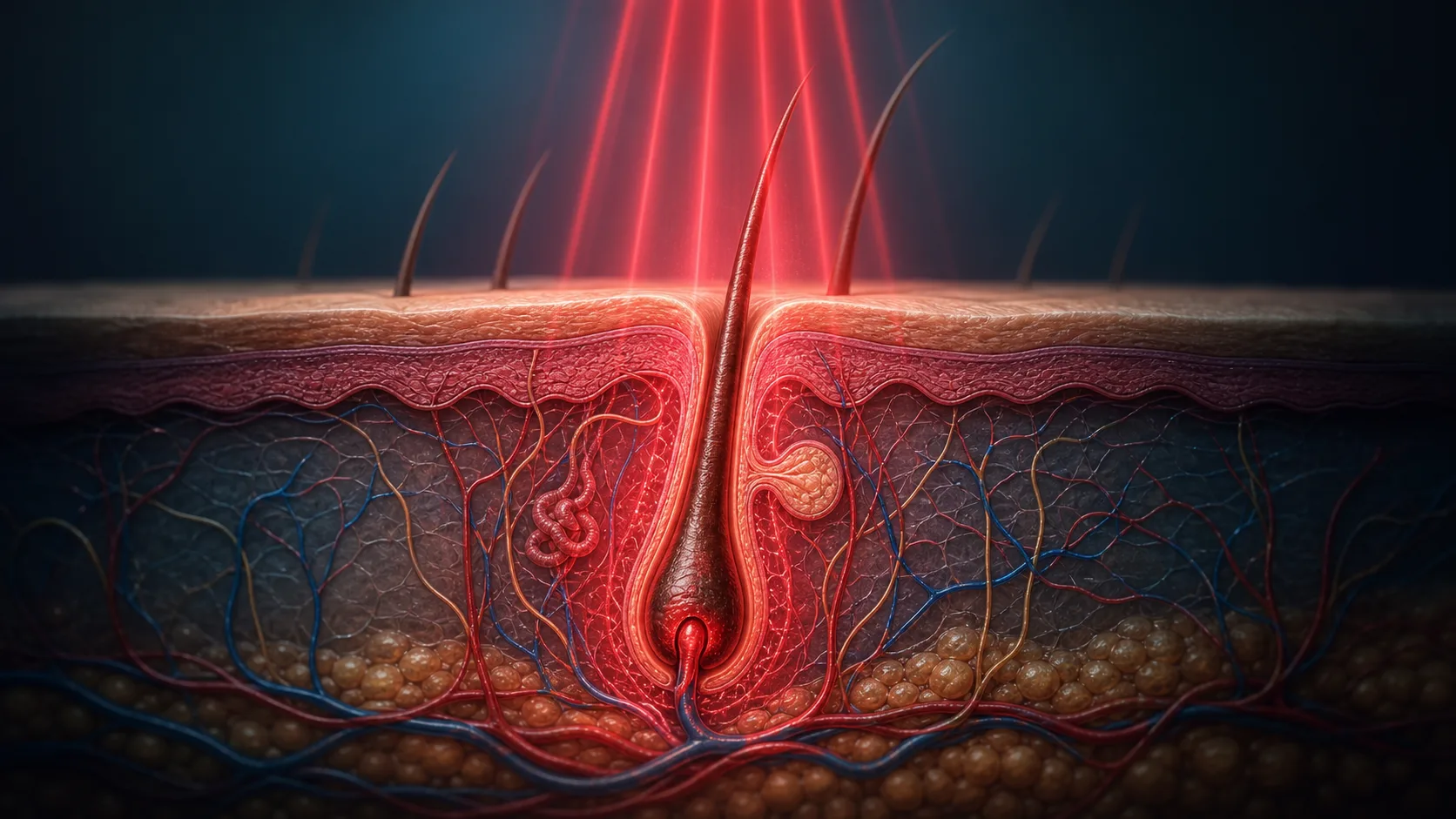
The reason people conflate these brands is that both rely on photobiomodulation, the same underlying mechanism in which red light is absorbed by cells and alters their behaviour. That mechanism does genuinely operate in both skin and hair follicles. What differs is which tissue the device is designed, dosed, and regulated to treat.
A hair helmet has to deliver a specific wavelength, at sufficient energy, through hair and scalp, to follicles below the surface, on a schedule the clinical trials support. A face mask has to deliver light to skin at the surface. The two are not interchangeable simply because both glow red.
If your goal is hair, buy a hair device
For androgenetic alopecia, the evidence sits with devices built and cleared for it. Low-level laser therapy has held FDA clearance for pattern hair loss since 2007, and the published trials, including a 12-month study of a helmet-type red-light device showing a mean gain of about 25 hairs per square centimetre at 48 weeks, used scalp devices, not skincare masks.
iRestore’s hair range is the Essential ($799), the Professional ($1,499) and the Elite ($2,699). For most people the Professional is the sensible choice; the Elite is for diffuse whole-scalp thinning.
iRestore Professional · $1,499
Affiliate link. We may earn a commission at no extra cost to you.
If your goal is skin
If you actually want LED skincare, note that iRestore sells its own line, the Illumina masks, at $499 for the Eye Mask, $649 for the Neck & Chest and $799 for the Face Mask. We reviewed them on our iRestore Illumina page, including the finding that the $1,947 “trio” bundle saves you exactly zero dollars against buying the three masks separately.
Omnilux is a credible LED skincare brand and worth considering on those terms. Just do not buy it expecting a hairline.
Which is better, iRESTORE or Omnilux?
For hair growth, iRestore, because it is engineered and FDA-cleared for androgenetic alopecia. Omnilux is an LED skincare brand, comparing the two only makes sense if you have not yet decided whether your target is scalp or skin.
Can I use an Omnilux mask on my scalp?
Skincare masks are shaped and dosed for facial skin, not for delivering light through hair to follicles beneath the scalp. Use a device designed for the tissue you are trying to treat.
Does red light therapy work for both skin and hair?
Yes, photobiomodulation has an evidence base in both. But the devices are engineered differently for each target, and a device cleared for one indication is not automatically effective for the other.
Verdict
Stop comparing these two. Decide first whether you are treating hair or skin. If it is hair, choose among the actual hair devices, iRestore, Theradome, HairMax, Capillus, and start with our laser cap comparison for the honest price-versus-coverage picture.